

ID Badge Design Guidelines
ID Badge Design Specifications and Guide
- AI Introduction
- ID Badge Print Technology
- ID Card Material
- RFID Card Printing, Lamination, and Slot-Punch Considerations
- Artwork Specifications
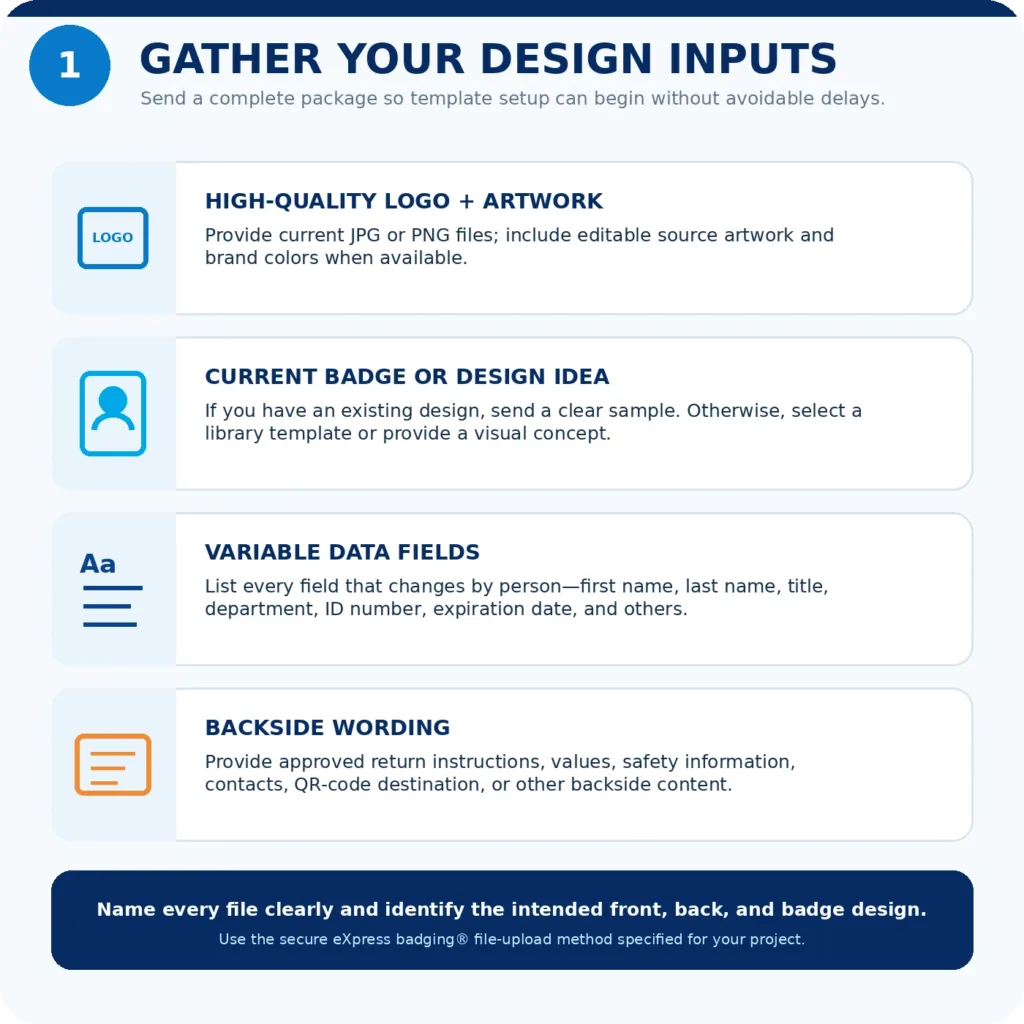
- Providing Artwork Files
- Color Matching
- Full Bleeds, Multiple Designs, and Color Coding
- Fonts and Licensing
- Font Attributes and Automatic Font-Size Reduction
- Badge Photos and Orientation
- Backside Printing: Make the Space Count
- Slot-Punch Planning and Card Durability
- Design Templates and Proofing
- Sample Badge Templates
- FILE to PRINT: Printing from Individual Badge Images
- Production Print Preview (P3)
- ID Badge Technology Testing
- DURABadge™ Warranty
AI-Assisted Review Tip
When you see the AI Starburst, use your preferred organization-approved AI tool and our section-specific guidance to help catch errors early and get it right the first time.
AI can assist—it cannot approve. Independently verify every finding and complete all required professional reviews, physical testing, human approvals, and production authorizations.


ID Badge Print Technology:
eXpress badging® uses professional dye-sublimation ID badge printing technology—the same type of technology organizations use to print badges in-house. Unlike standard office printing, dye-sublimation uses heat to transfer color onto PVC or composite card stock. This process produces high-quality ID badges but also has specific design requirements and acceptable production tolerances.
The eXpress badging® Production team will create your badge printing template using the artwork, data fields, photos, and specifications provided and approved by your organization. The following ID badge design guidelines will help you prepare these elements, avoid common printing issues, and achieve the best possible results.
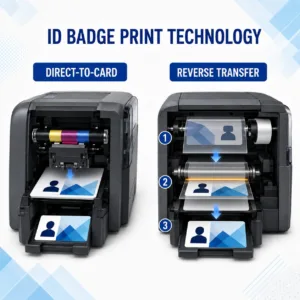
Dye-Sublimation Printing Expectations
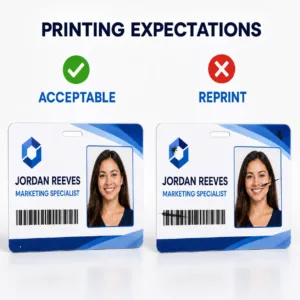
Minor cosmetic imperfections are an acceptable part of the dye-sublimation printing and lamination processes. These processes may occasionally produce slight variations or imperfections. An imperfection is considered acceptable when it does not interfere with the photo, text, logo, barcode, or the badge’s overall appearance under normal viewing conditions.
Acceptable Printing and Lamination Imperfections Include:
- Fine debris or lint particles outside the photo, text, logo, barcode, or other critical printed areas.
- Minor variations in the shade of white PVC or composite card stock between material batches or card technologies.
- Slight color variations resulting from differences in printers, ribbons, card stock, or printing technology, provided they are not noticeable under normal viewing conditions.
- Printed names that extend to the edge of the card but remain fully visible and are not truncated.*
Unacceptable Printing and Lamination Imperfections—Cause for Reprint:
- Printing imperfections, embedded particles, debris, or lint within the photo, text, logo, barcode, or other critical printed areas that are noticeable under normal viewing conditions.
- Debris or air bubbles between the card surface and laminate that are noticeable under normal viewing conditions.
- Printed names that extend beyond the edge of the card or are truncated.*
*Truncation caused by data exceeding the maximum field length is considered acceptable when automatic font-size reduction has been specifically disabled.
Considerations for Badges Produced in the eXpress badging® Standard Format or Without Lamination:
- Extended exposure to sunlight may cause the printed image to fade within weeks or months.
- Badges produced in the eXpress badging® Standard format are not covered by a warranty against fading, cracking, or breaking.
- Printed barcodes are not covered by warranty and may wear away within weeks or months, depending on handling and use.
If a badge produced in the eXpress badging® DURAbadge™ format fades, cracks, or breaks within 24 months of its ship date, please review the DURAbadge™ warranty below to determine whether the badge qualifies for replacement.
ID Card Materials
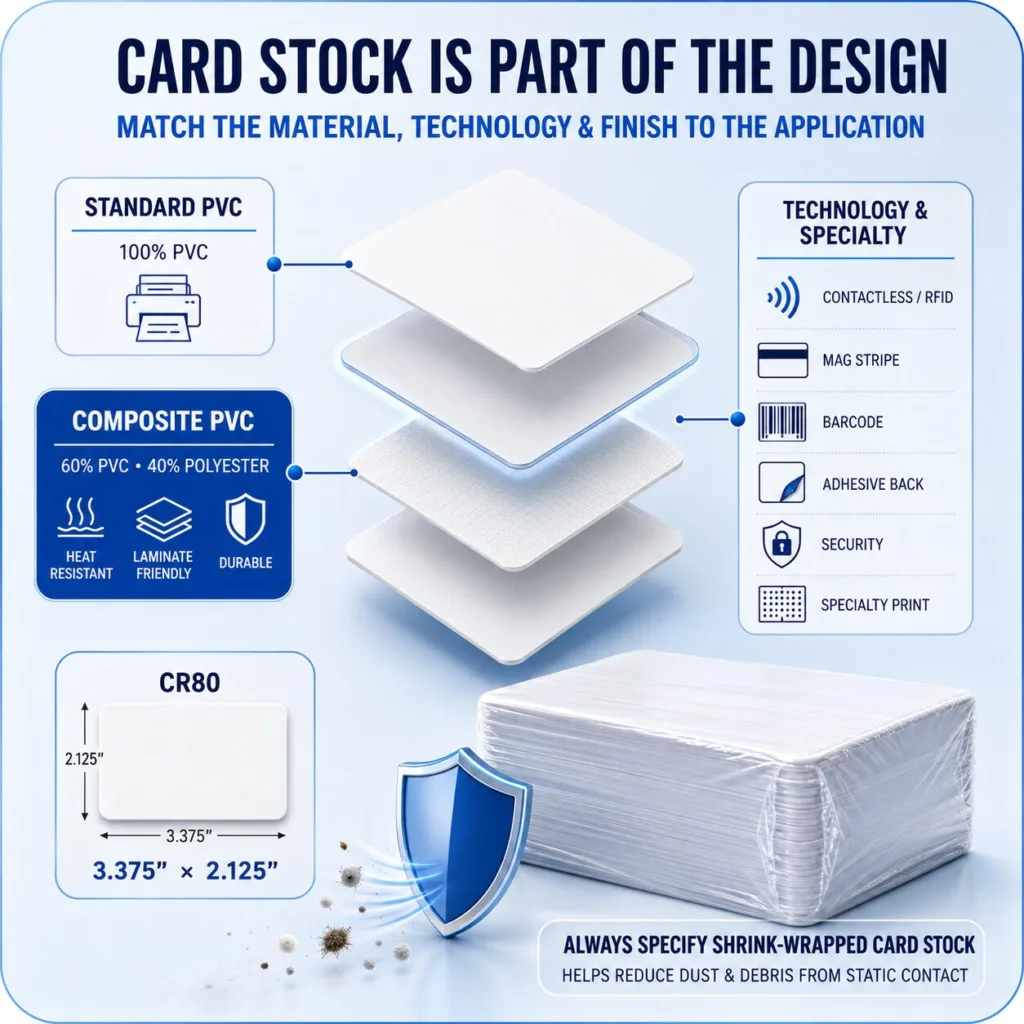
The eXpress badging® Production team prints photo ID badges on white PVC card stock. The shade of white may vary between standard 100% PVC cards and composite cards made from 60% PVC and 40% polyester. Because raw materials and manufacturing processes vary, an exact match in the shade of white cannot be guaranteed across different card technologies, manufacturing batches, or future orders.
The eXpress badging® Production team always specifies shrink-wrapped card stock to help protect card surfaces from dust and debris attracted by static electricity before printing.
Additional card materials and technologies are available for specialized applications. Cards that differ from the standard CR80 size of 3.375″ × 2.125″ are considered custom and may require additional production time and cost.
- Technology Cards
- RFID proximity cards
- RFID MIFARE® and other contactless smart cards
- Magnetic-stripe cards
- Cards printed with barcodes
- ID Badge Options
- Lamination for increased durability and fade protection
- Adhesive-backed card stock
- Tri-modal security seals
- UV ink printing
- Foil stamping
RFID Card Printing, Lamination, and Slot-Punch Considerations
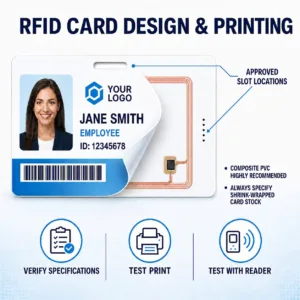
RFID cards contain an embedded chip and antenna that may create surface irregularities. When printed using a direct-to-card (DTC) PVC card printer, these irregularities can cause color variation, image distortion, or unprinted areas over or near the chip and antenna. Whenever possible, critical design elements—including photos, names, logos, barcodes, and small text—should be positioned away from these areas.
A bright mobile-phone flashlight may help reveal the antenna location in some RFID cards. However, this method should not replace the card manufacturer’s specifications, antenna diagram, or designated slot-punch markings.
Slot-Punch Location Is Critical
- Punching through an RFID antenna will permanently damage the card and prevent it from working with the intended card reader.
- Many RFID cards include dotted lines, arrows, notches, or other markings that identify an approved slot-punch location.
- Depending on the card’s construction, an approved location may be provided on the long edge, short edge, both edges, or neither edge.
- Some RFID cards are not designed to be slot-punched.
- Never assume that an RFID card can be punched in the same location as a standard PVC card or another RFID card model.
- Before punching an entire batch, confirm the approved location with the card manufacturer or supplier. Print, laminate, and slot-punch one card, and then test it with the intended reader.
Printing and Durability Recommendations
- Test any new or unfamiliar RFID card using the actual card design, printer, ribbon, and lamination process before beginning full production.
- Reverse-transfer printing may provide better print coverage and image quality on cards with uneven surfaces or embedded electronics.
- Composite cards made from 60% PVC and 40% polyester are generally recommended for laminated cards because they better withstand the heat and pressure of the lamination process.
- Applying a 1-mil laminate patch to each side can provide additional durability and help reduce image fading caused by sunlight exposure.
- Confirm that the selected card stock, printer, laminate, and slot-punch location are compatible before ordering or producing a complete batch.
Contact your eXpress badging® ID Specialist for assistance selecting, designing, printing, laminating, or slot-punching RFID cards.
Artwork Specifications
Artwork for Badge Designs:
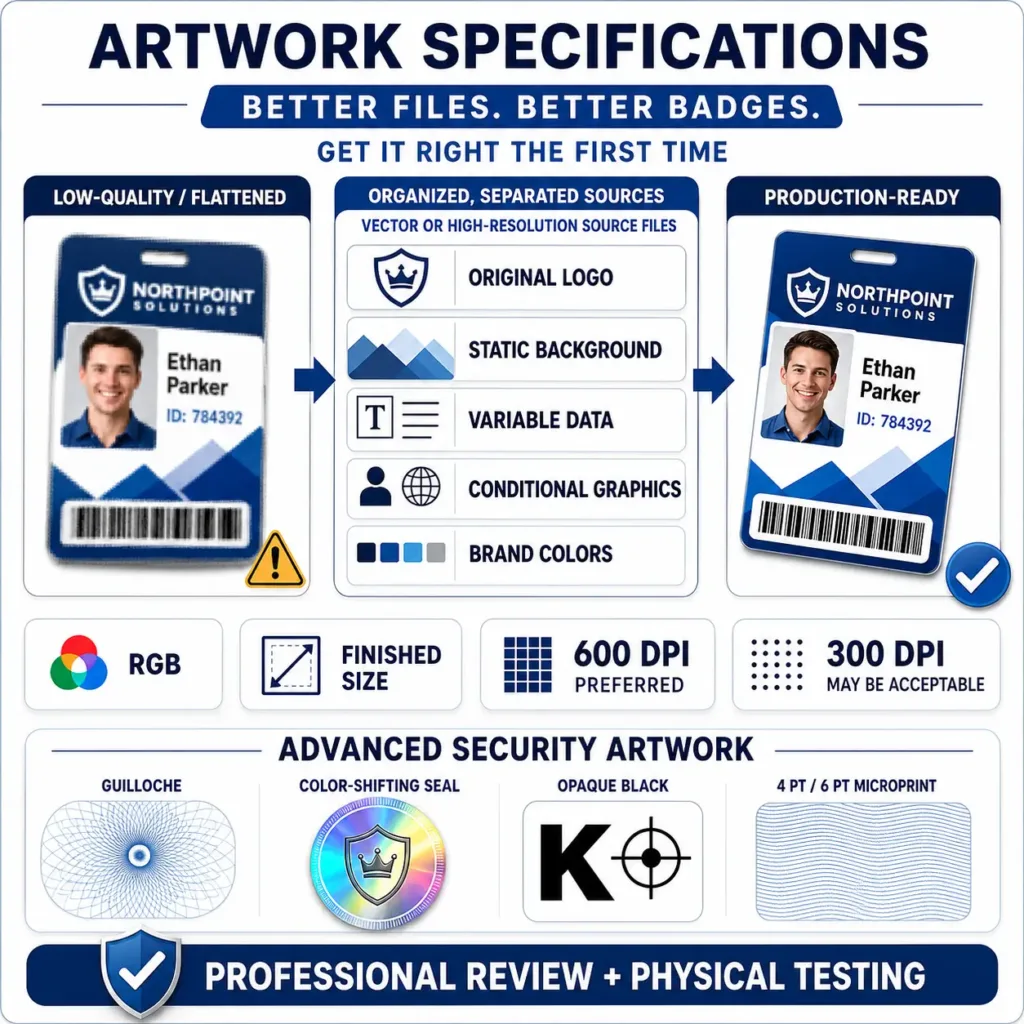
- Provide the highest-quality, current artwork available for logos, service marks, trademarks, static graphics, and brand colors.
- Whenever possible, obtain original source artwork and current brand guidelines from your organization’s marketing or communications department.
- Low-quality, flattened, or incomplete artwork may require billable professional artwork services before it can be used.
- Provide a static background graphic for use in the badge printing template.
- Do not include employee photos, names, identification numbers, barcodes, or other variable information in the static background graphic.
- Separate mockups showing the intended placement of photos, text, and other variable elements may be provided for reference.
- If you submit a complete badge design containing variable elements, provide a layered PSD or editable PDF that allows the static background and variable elements to be separated.
- A flattened JPG, PNG, or PDF may be used as a visual reference, but artwork that cannot be separated may need to be recreated for an additional fee.
- Provide separate graphics for elements that print only when specified conditions are met.
- For example, when the Certification field contains “Forklift,” a corresponding forklift-certification graphic can be added to the badge.
Preferred File Types and Settings:
- Prepare artwork in RGB color mode.
- Provide artwork at the intended print dimensions.
- A resolution of 600 DPI is preferred.
- A resolution of 300 DPI may be acceptable for less-detailed artwork when supplied at its intended print size.
- Use the file format appropriate for the artwork:
- Transparent PNG for logos or graphics requiring a transparent background.
- High-quality JPG or PNG for badge backgrounds and design mockups.
- Layered PSD or editable PDF for complete badge designs that require individual elements to be separated.
- The eXpress badging® Production team normally accepts JPG, PNG, PSD, and PDF artwork files. Other file types may require conversion or professional artwork services.
- Maintain the artwork’s original proportions when resizing. To preserve image quality, do not enlarge or reduce raster artwork by more than approximately 25%.
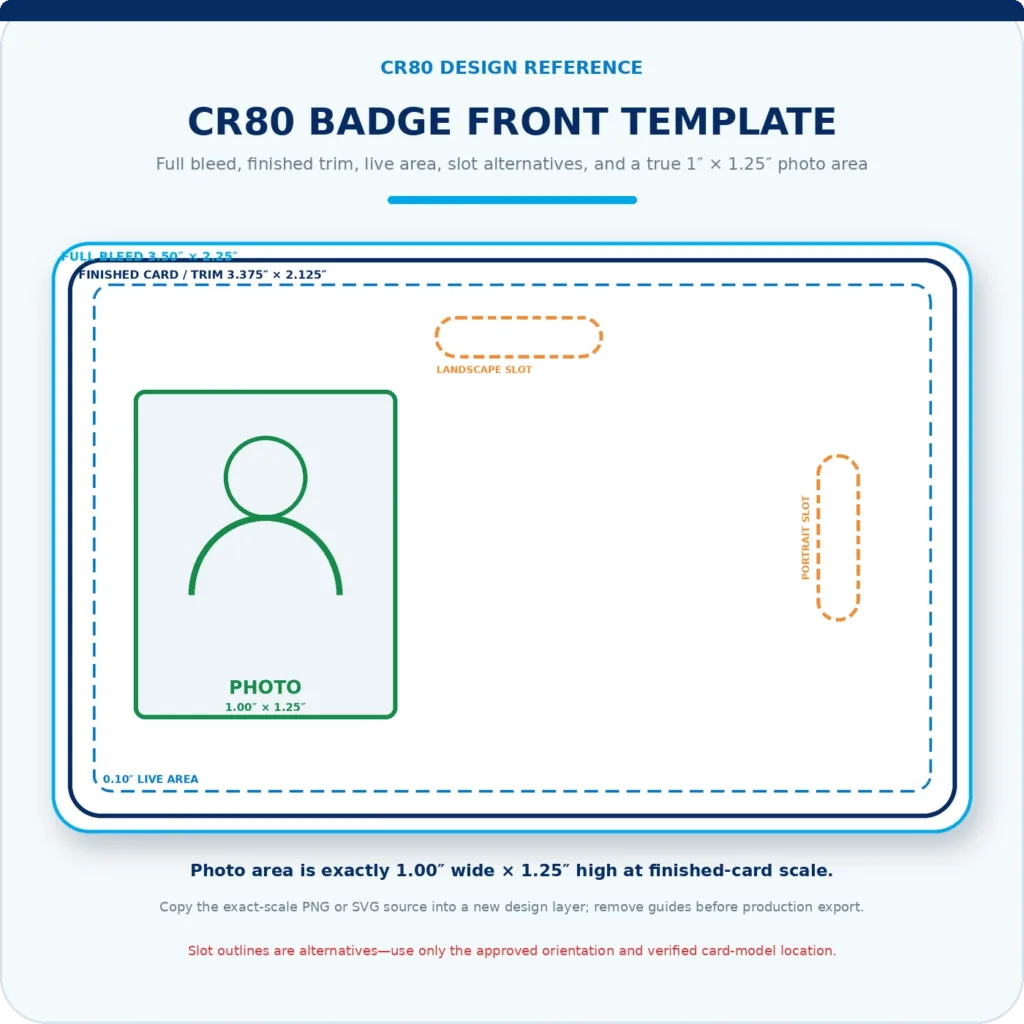
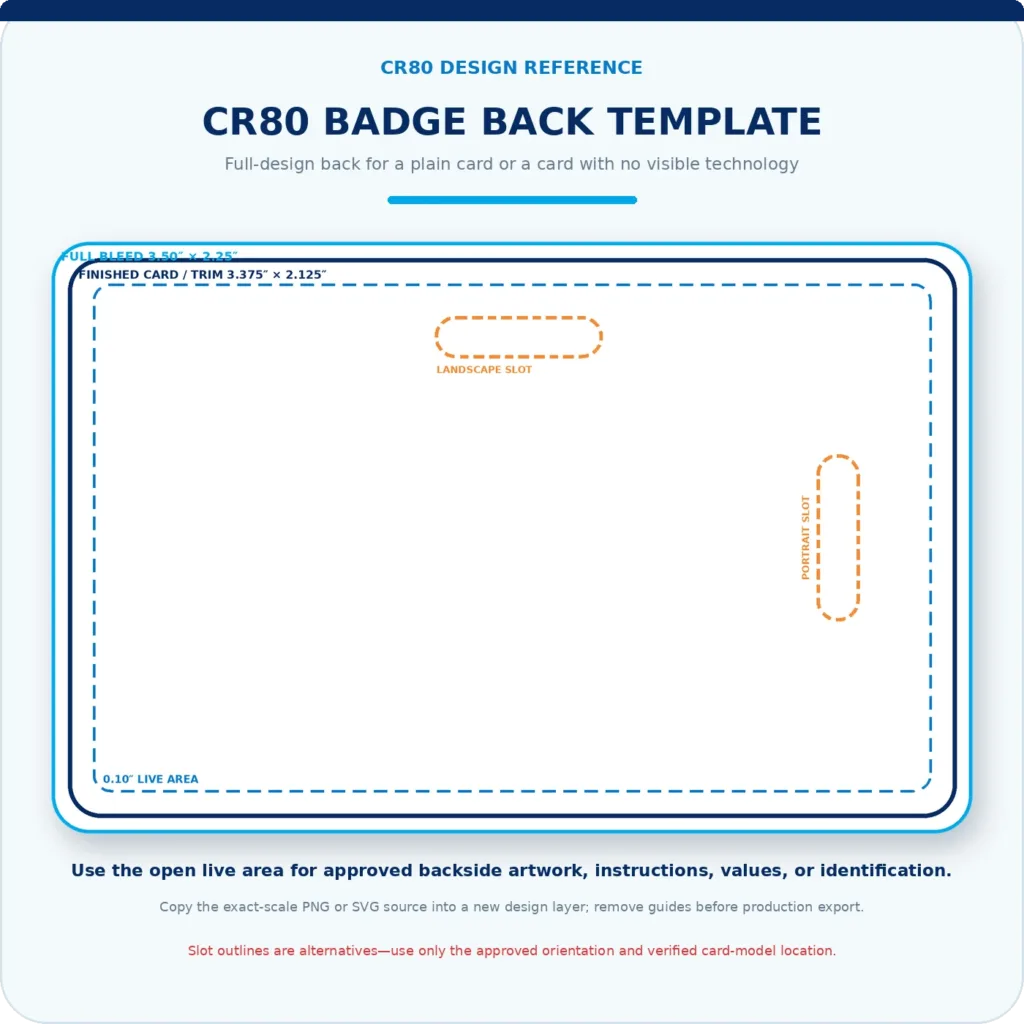
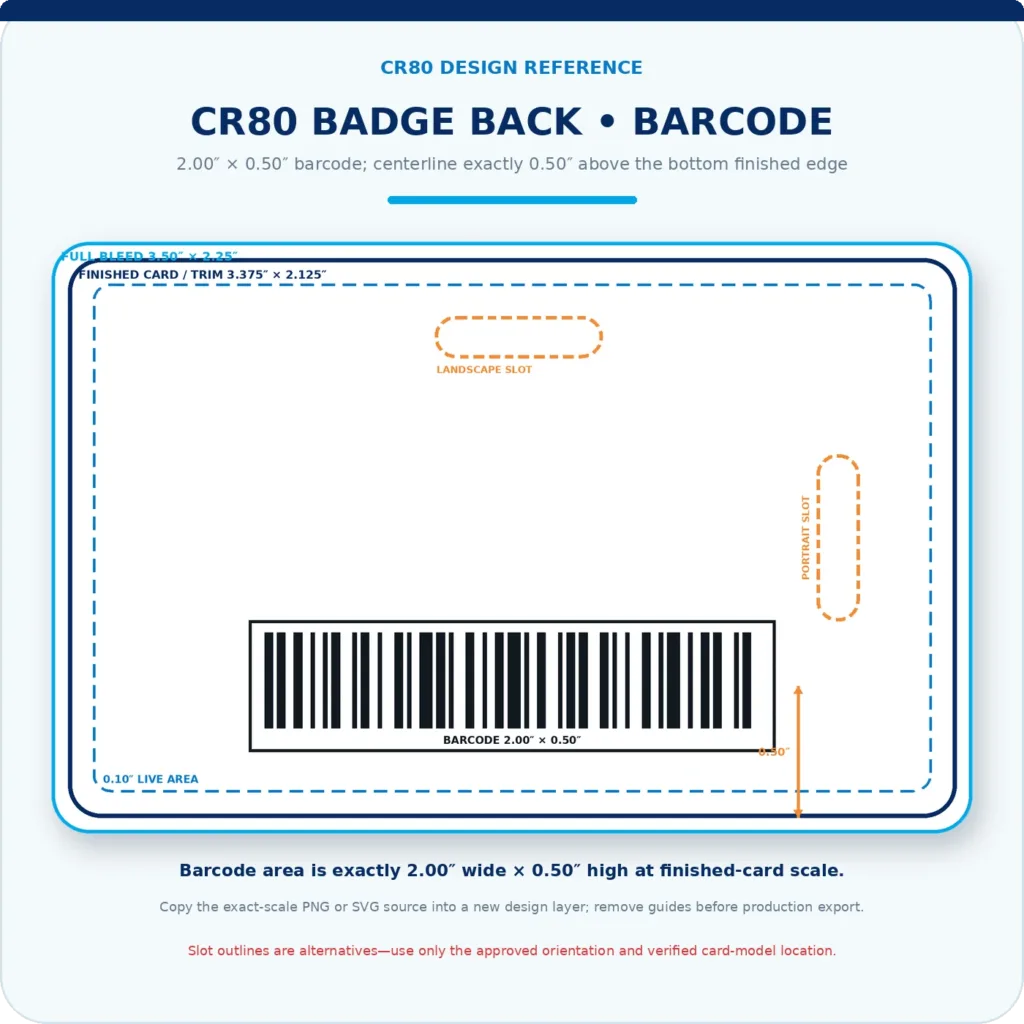
- The finished standard CR80 badge size is 3.375″ × 2.125″ (3-3/8″ × 2-1/8″).
- Full-bleed designs and completed FILE-to-PRINT images have different file-dimension requirements. Refer to the corresponding sections below before preparing those files.


Mouse Over For Data and Photo Merge
Providing Artwork Files
eXpress badging® provides several secure methods for submitting artwork files:
- Use the ID Badge File Upload Center.
- Review the Upload Center Instructions before submitting your files.
- For artwork files larger than 10 MB, we can provide access to a secure ShareFile account.
- By prior arrangement and authorization, our team can remotely assist in retrieving artwork from your organization’s server.
Color Matching
Dye-Sublimation Color-Matching Expectations:
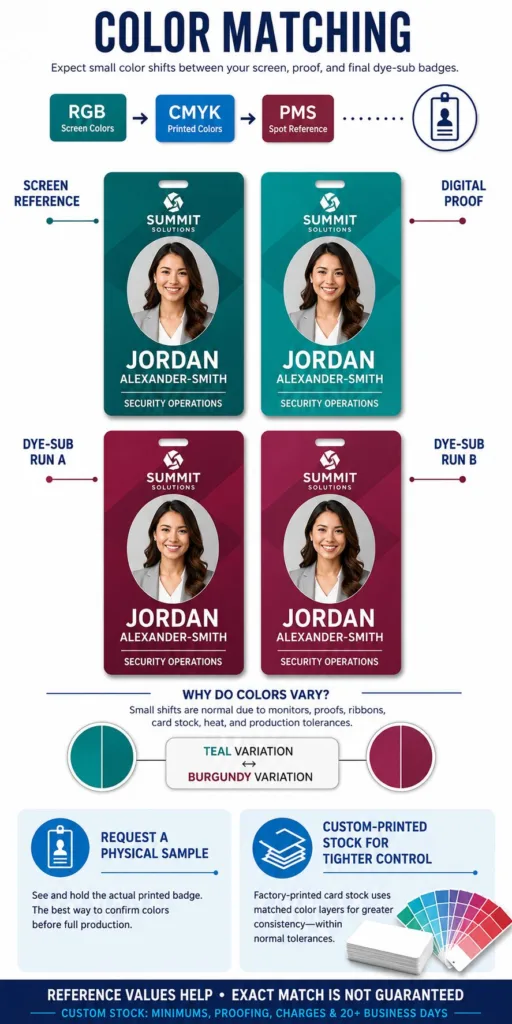
The eXpress badging® Production team will make every reasonable effort to reproduce your organization’s colors as closely as possible. However, exact matching to RGB, CMYK, or Pantone Matching System (PMS) color values cannot be guaranteed when printing ID badges using dye-sublimation technology.
- Submit artwork in RGB color mode as specified in the Artwork Specifications section.
- Provide the applicable RGB, CMYK, or PMS color values as references when color consistency is important.
- Colors displayed on a computer monitor or produced by an office printer may not accurately represent the final badge color.
- Printed colors may vary because of differences in monitors, color profiles, printers, ribbons, transfer films, card stock, printer settings, and production technologies.
- Minor color variations between production runs, card materials, printers, or future equipment upgrades are considered acceptable.
- Teal, burgundy, and certain other colors can be particularly difficult to reproduce consistently. Additional test printing or color adjustment services may be recommended and may incur additional charges.
If color accuracy is especially important, request a physical printed sample before approving full production. A digital proof can confirm the design, content, and general color appearance, but it cannot guarantee the exact color of the finished badge.
Custom-Printed Stock for Tighter Color Control:
Organizations requiring tighter color control should consider factory-printed custom cardstock. Depending on the printing method, PMS spot colors may be available and must be identified in the artwork and included in the approved order specifications.
- Custom-printed stock may involve minimum order quantities, proofing requirements, setup charges, spot color charges, and other production costs.
- Plan for a lead time of at least 20 business days after final artwork, specifications, pricing, and proofs have been approved.
- Actual production time may vary based on the card material, printing method, technology requirements, quantity, and manufacturer availability.
Even with custom-printed stock, reasonable manufacturing and material tolerances may apply.
Full-Bleed Designs, Multiple Designs, and Color Coding
Full-Bleed Designs:
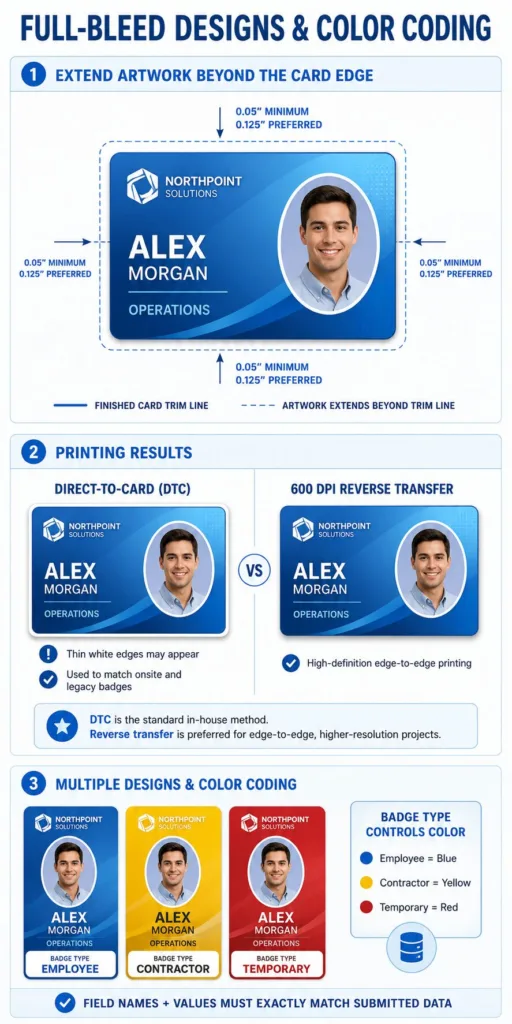
Direct-to-card (DTC) PVC card printers—the standard printers most organizations use for in-house badge production—do not print completely over the edges of a card. As a result, a thin white border may appear along one or more edges of a full-bleed design.
For the best possible results, extend the artwork beyond the finished card dimensions on every edge intended to bleed. A minimum extension of 0.05″ is required; however, a 0.125″ extension is preferred.
The eXpress badging® Production team primarily uses high-definition, 600 dpi reverse-transfer printers for projects requiring edge-to-edge printing and higher-resolution graphics. For these projects, extend the artwork 0.125″ beyond each edge intended to bleed.
The eXpress badging® Production team also maintains a small fleet of direct-to-card printers. These printers allow us to match badges previously printed onsite by customers, including badges produced for rebadging projects.
Multiple Designs and Color Coding:
If your project includes multiple badge designs or uses color coding, provide a cross-reference that identifies the data field and field value that determine which design or color is assigned to each badge.
For example, if the Badge Type field controls the badge color:
- Employee = Blue
- Contractor = Yellow
- Temporary = Red
The field names and values in the cross-reference should exactly match the data submitted for badge production.
Fonts and Licensing
Arial and Restricted-Font Transition Notice
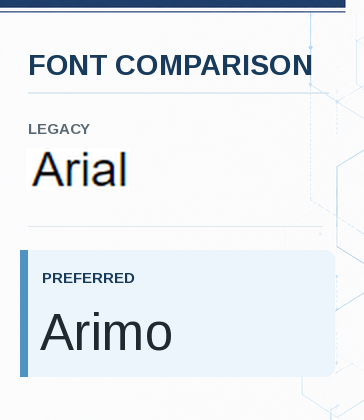
Arial and other proprietary or otherwise restricted fonts are being discontinued within the Veonics® Portal effective December 1, 2026. These fonts remain temporarily available only to support existing badge templates during the transition. If your organization holds a current font license that expressly permits the eXpress badging® team to install, host, and use the font within a third-party software-as-a-service environment, please provide the license agreement or other acceptable documentation for review.
Do not create a new badge template or redesign an existing template using Arial or another affected font. Use Open Sans or another currently approved open-source replacement. Arimo is the proposed preferred Arial replacement and is undergoing an expedited review of licensing, file verification, and technical compatibility before its anticipated addition to the Veonics® Portal.
Changing a font may affect character width, line wrapping, automatic font-size reduction, spacing, and alignment. Every converted template must therefore be reviewed through the applicable Veonics® Virtual ID process. We Print customers may also request formal proofing before the updated template is approved for production.
Variable-Data Fonts
Photo ID badges are first and foremost tools for secure identification. Names, titles, identification numbers, expiration dates, and other variable information must remain clear, readable, and consistently formatted.
For most organizations, a standard Veonics® Portal font is appropriate for variable badge data. Logos, colors, background artwork, and layout typically provide the strongest brand presentation, while differences among similar professional fonts used for variable information are often difficult to notice.
The eXpress badging® team is currently reviewing the fonts available within the Veonics® Portal for licensing and technical compatibility.
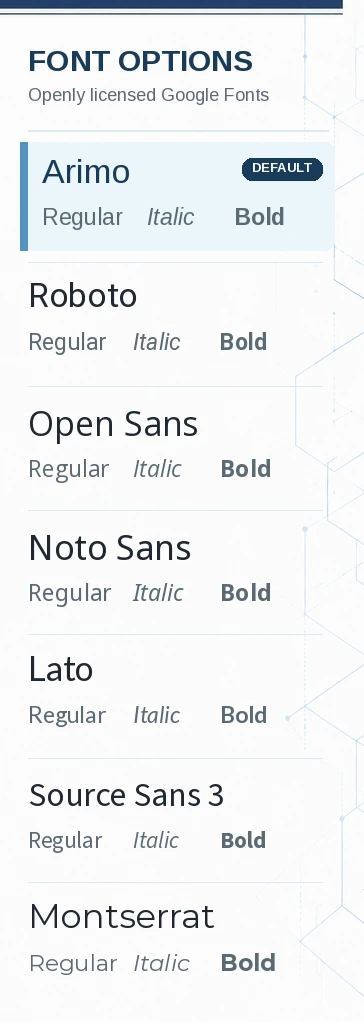
- Open Sans is the interim standard for new badge templates while the formal font review is underway.
- Arimo is the proposed preferred default and Arial replacement. Arimo is undergoing an expedited licensing, file-verification, and technical-compatibility review before final approval.
- The other font families shown in this section are candidate options under review. Their inclusion does not indicate final approval.
- Except for Arial and other fonts covered by the transition notice above, existing badge templates do not need to be changed solely because a font is currently under review. The eXpress badging® team will provide guidance if a template requires licensing review, proofing, or transition.
Fonts selected for Veonics® Portal use are evaluated for common badge-production requirements, including:
- Readability and character spacing
- Regular, bold, italic, and bold italic styles, when supported
- Line wrapping and automatic font-size reduction
- Long names, titles, and identification numbers
- Accented characters and required language support
- Browser previews
- Image and PDF generation
- Badge printing
Corporate and Customer-Provided Fonts
Fonts are licensed software. A font licensed for use in desktop documents, presentations, logos, or marketing materials may not be licensed for installation or use within cloud-based software or by a third-party badge-production provider.
Organizations requesting a specific corporate font for editable or variable badge data must provide sufficient licensing documentation for review. Providing a font file does not, by itself, establish that the font may legally be installed, hosted, reproduced, or used by the eXpress badging® team or within the Veonics® Portal.
The eXpress badging® team will contact the authorized representatives of organizations currently using a customer-provided font to:
- Register the font in the Veonics® Font Registry;
- Identify the badge templates using the font; and
- Retain evidence of a valid, current license permitting the required use.
Depending on the production workflow, the license may need to permit third-party service-provider use, server or software-as-a-service use, browser display, image or PDF generation, variable-data production, and commercial badge printing.
If the license is expired, cannot be verified, or does not authorize the required use, the organization must either:
- Obtain the necessary licensing rights and provide current supporting documentation; or
- Convert the affected badge template to an approved open-source font available within the Veonics® Portal.
A customer-provided font that has not been registered and supported by acceptable licensing documentation may not be used in a new or revised badge template. An existing template using a noncompliant font must be brought into compliance or converted to an approved replacement before the applicable transition deadline.
Additional licensing, configuration, testing, design, or professional-service charges may apply. If the required rights cannot be verified, the eXpress badging® team may recommend the current approved or interim standard font.
Corporate typography may still be incorporated into properly licensed static badge artwork by:
- Converting the text to outlines in vector artwork; or
- Including the text within a flattened, print-ready background image.
Outlined or flattened text cannot be used for names, titles, identification numbers, or other information that changes with each badge record.
Any font replacement must complete the applicable template-review and approval process because changes in character width, spacing, line wrapping, and automatic font-size reduction may affect the finished badge design.
For font availability, licensing-documentation requirements, customer-provided fonts, and static-artwork alternatives, review Font Use and Licensing Within the Template Designer.
Candidate Font Options Under Review
Font Attributes and Automatic Font-Size Reduction
Font attributes—including the font family, style, size, color, alignment, and automatic font-size reduction—are configured within each text field of the badge template.
Automatic Font-Size Reduction
Automatic font-size reduction is generally recommended for variable merge fields such as:
- First name
- Last name
- Full name
- Title
- Department
- Identification number
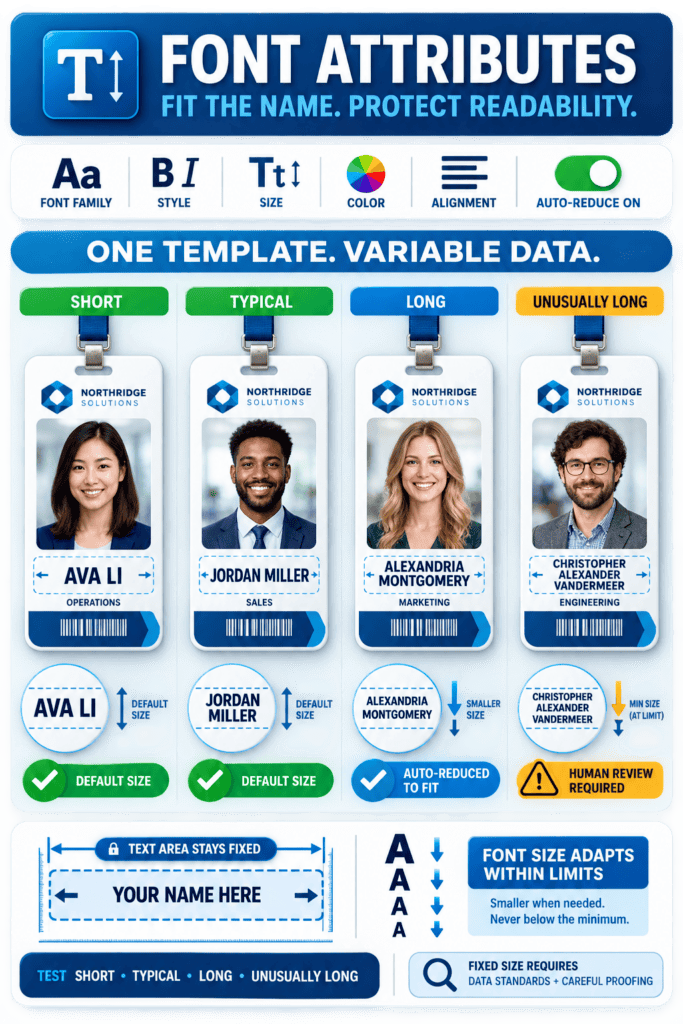
When automatic font-size reduction is enabled, the text begins at the field’s configured default size. If an entry is too long for the defined text area, the Veonics® Portal automatically reduces the font size within the configured limits to help the text fit.
As a result:
- Shorter entries appear at the preferred default size.
- Longer entries may appear at a smaller size.
- Font sizes may vary among badges produced from the same template.
- Exceptionally long entries may still exceed the available space if they cannot fit within the field’s permitted size range.
The text area should be designed and tested using short, typical, and unusually long sample entries. The selected font can also affect how much text fits because character widths and spacing vary among font families.
Fixed Font Sizes
If consistent font size is more important than accommodating different text lengths, automatic font-size reduction may be disabled. In that case, the font remains at its configured size regardless of the length of the badge data.
Before approving a fixed-size field, your organization should:
- Determine the maximum number and combination of characters that will fit
- Test representative long names, titles, departments, and identification numbers
- Establish data-entry standards or approved abbreviations
- Review badge proofs carefully
- Correct or shorten entries that exceed the available space
Text submitted for a fixed-size field may be clipped, extend outside the text area, overlap another design element, or otherwise print improperly when it exceeds the available space.
The eXpress badging® Production team will print badge data according to the approved template and the information submitted by your organization. Reprints resulting from customer-provided data that exceeds the approved fixed-size field may be subject to additional charges.
For most variable badge information, automatic font-size reduction provides the best balance among readability, consistency, and support for varying data lengths.
Badge Photos and Orientation
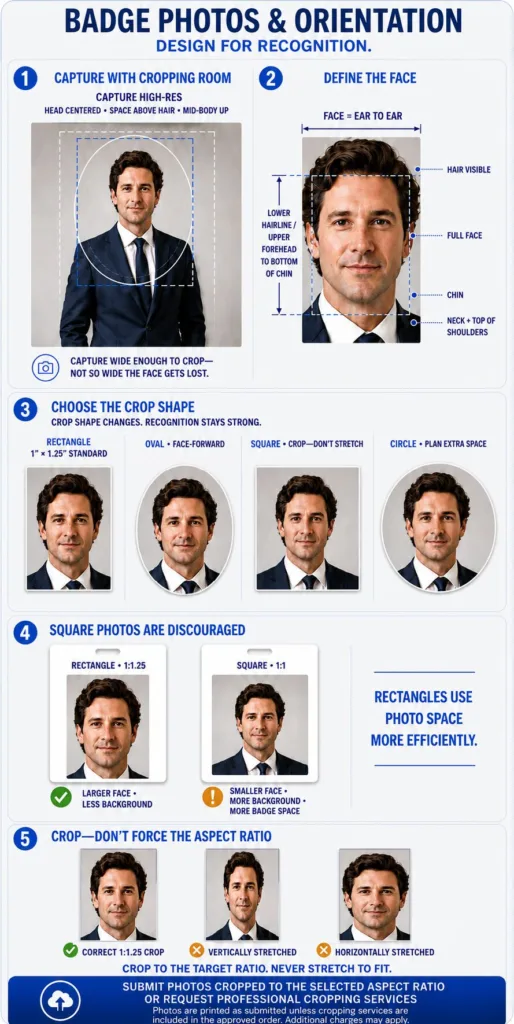
- We suggest using cropped rectangular headshots that show the person’s entire face, with minimal background visible.
- The standard industry size for a badge photo is 1″ × 1.25″, with a 4:5 aspect ratio.
- Photo Cropping and Headshot Position
- Badge photos should be centered and show the person’s complete face from ear to ear and from the top of the head to the chin. Most, if not all, of the person’s hair should remain visible within the cropped photo.
- Proper positioning is especially important when using oval or circular photo crops. As a general guideline, the face—measured from ear to ear—should occupy approximately:
- 75% (3/4) of the photo width for rectangular photos.
- 65% (approximately 2/3) of the photo width for oval photos.
- 50% (1/2) of the photo width for circular photos.
- These proportions provide sufficient space around the person’s head and help prevent the face, hair, or other important details from being cut off by the selected photo shape.
- When capturing a high-resolution source image, photograph the person from approximately mid-body upward, keeping their head centered. This provides sufficient space for the photo to be zoomed and cropped correctly before submission.
- Photos are printed as submitted. Our Production team does not retouch, reposition, zoom, or individually crop submitted photos unless a photo-cropping service is procured and specified in your order. Oval and circular photo masks change the photo’s visible appearance but do not automatically reframe/center the person’s face. Please review and properly position each photo before submitting it.
- If you choose different dimensions, it may affect previously captured images and their appearance.
- Previously cropped images are converted to low-resolution images, which can cause issues when resizing.
- Please note that we are unable to convert rectangle-cropped photos to squares.
- Even though we can convert a square to a rectangle, the entire headshot width must be reduced and within the rectangle cropping guide; otherwise, the image’s sides will be truncated.
- We provide oval and circular photo printing.
- For ovals, we use rectangular-cropped photos.
- For circles, we use square-cropped photos.
- The corners of square photos will not appear when a circular photo mask is applied.
- We recommend using color bars and thick borders to make color codes easily identifiable and noticeable.
- We do not recommend using colored photo backgrounds.
Backside Printing: Make the Space Count
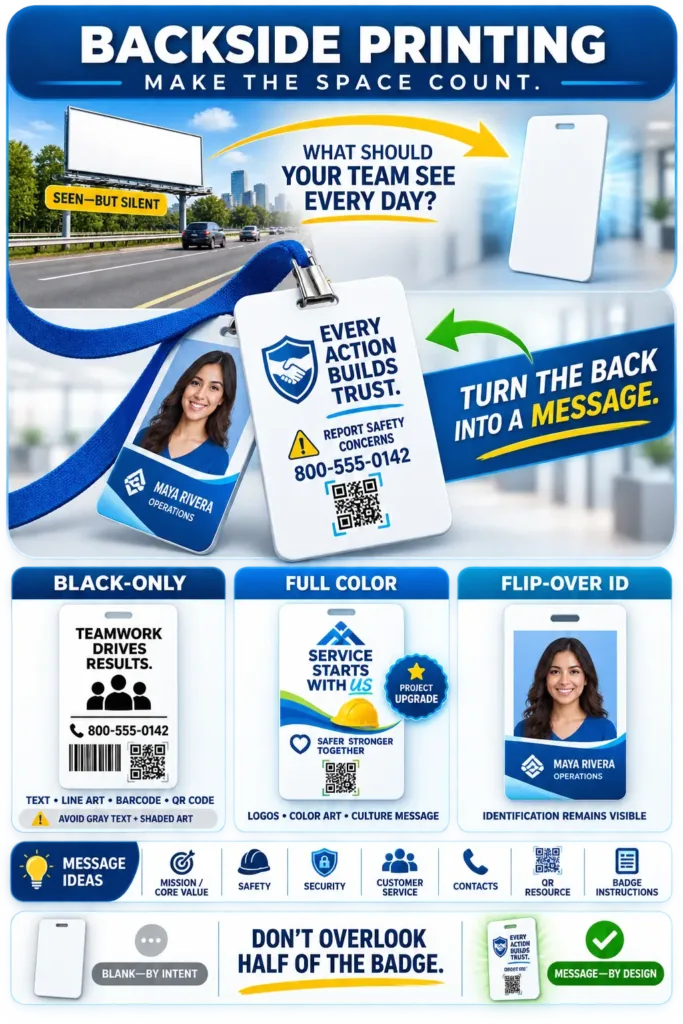
The back of an ID badge is often overlooked, yet employees may handle, display, or look at their badges every day.
Leaving the back of an ID badge blank is like putting up a blank billboard on a busy highway: many people will see it, but no one will receive the message.
Before deciding to leave the back blank, ask your leadership team:
“We are about to issue badges throughout our organization. What important message, information, or organizational value should employees see on the back?”
Consider using the back for:
- Your mission statement or an important Core Value
- Emergency or safety instructions
- Security reminders or reporting information
- Customer-service expectations
- Important telephone numbers or website information
- A QR code linking to an approved organizational resource
- Badge-use, access, or return instructions
- A simplified or duplicated version of the badge front
Duplicating the front design on the back can be especially useful. If the badge flips while being worn, the individual’s identification remains visible.
A traditional “If found, return to” statement may be helpful, but it should not be selected automatically without considering whether the space could deliver a more valuable message.
Black-Only Backside Printing
Unless otherwise included in the approved project specifications, backside printing is produced in black only.
Black-only printing works best for solid black text, line art, barcodes, and QR codes. Grayscale images, shaded artwork, and gray text are not recommended because they may reproduce with a coarse, dotted, or pixelated appearance.
Provide backside text in a Microsoft Word document or text file. Review our Backside of an ID Badge guidance for ideas and submission information.
Full-Color Backside Printing
Full-color printing is available when the back includes photographs, logos, colored artwork, or a duplicated version of the badge front. Because full-color backside printing requires additional production materials and processes, it must be included as an upgrade in the approved project specifications and will increase the badge cost.
If your organization determines that nothing on the back would add meaningful value, leaving it blank remains an appropriate choice. The important thing is to make that decision intentionally rather than overlooking half of the available badge space.
Slot-Punch Planning and Card Durability
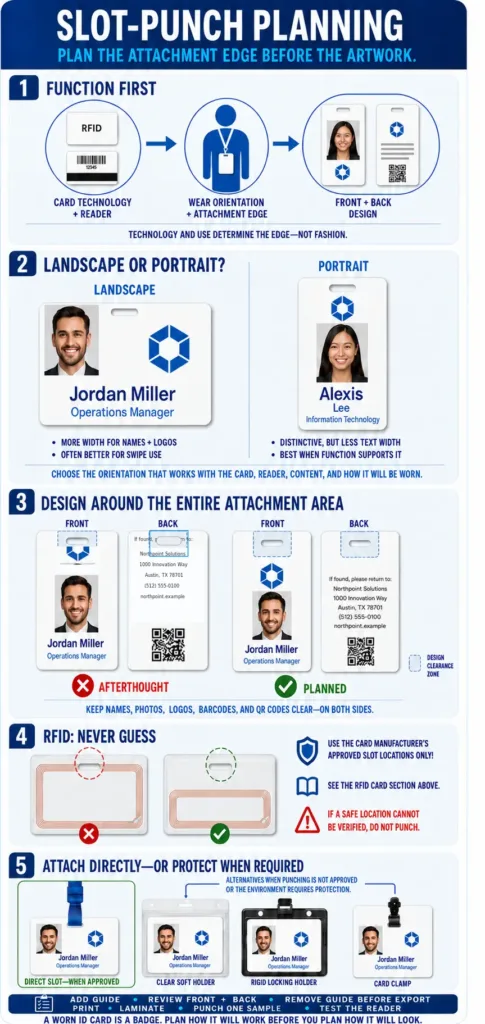
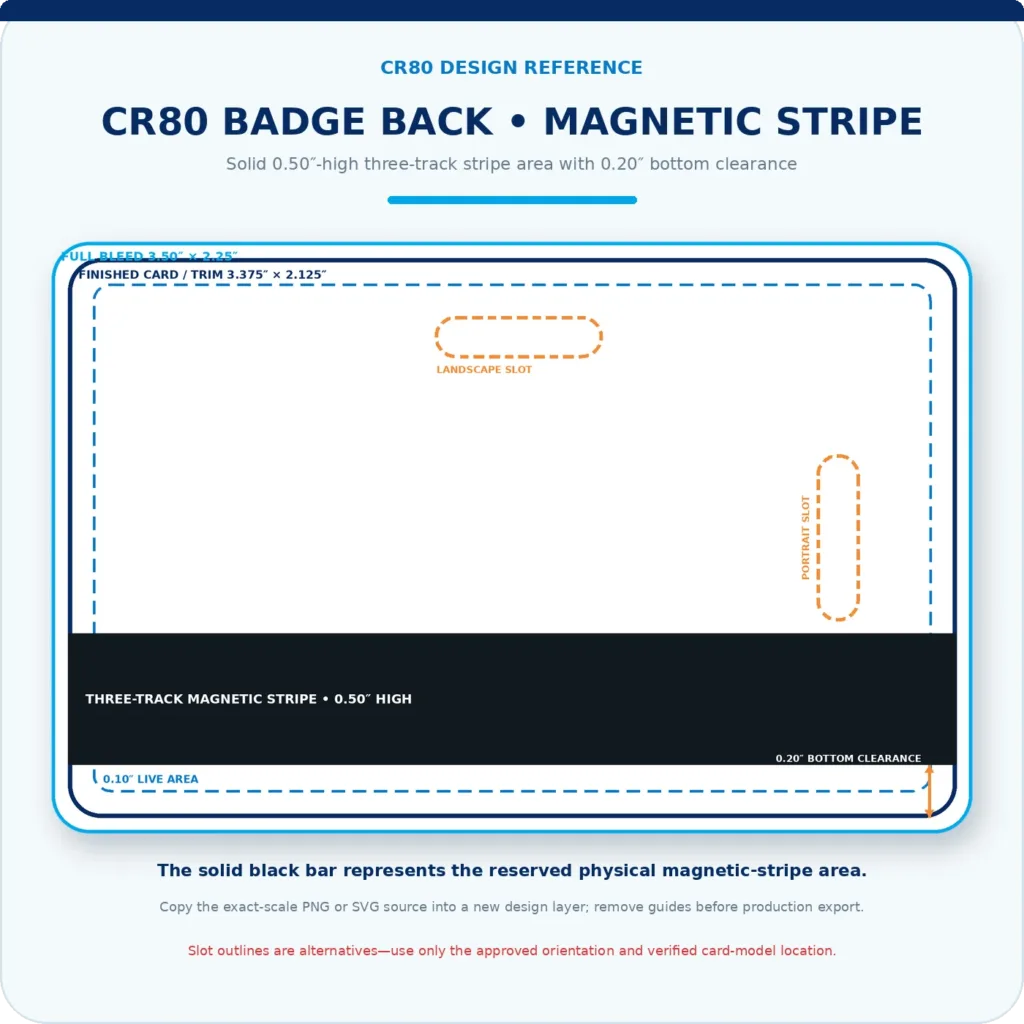
Many photo ID badges are slot-punched so they can be attached directly to a clip, lanyard, or badge reel. The slot removes material near the edge of the card, so its location must be considered when designing both the front and back of the badge.
A typical slot opening is approximately 0.55″ to 0.625″ wide and 0.15″ high. However, the exact dimensions and position may vary based on the slot punch, card orientation, attachment, card construction, and embedded technology.
Use the slot guide provided for your project rather than relying only on general measurements.
Designing Around the Slot
When preparing badge artwork:
- Add a nonprinting slot placeholder to both the front and back designs.
- Confirm whether the badge will be worn in portrait or landscape orientation.
- Keep names, logos, photographs, barcodes, QR codes, and other important elements outside the slot and its surrounding safety area.
- Allow additional space around the slot so the attachment does not cover important information.
- Review the complete design with the slot placeholder visible.
- Hide or remove the slot placeholder before exporting the final background artwork.
The slot placeholder is a design guide only. If it remains visible in the final background file, it may print on the finished badge, and portions of the printed guide may remain visible after the slot is punched.
Printing and Punching Sequence
Badges should generally be printed and laminated before they are slot-punched. Printing a card that has already been punched may damage the printer ribbon if the edge of the slot contains a burr or sharp surface.
Before beginning full production, produce, finish, and slot-punch a sample badge to confirm:
- Slot location and alignment
- Clearance around printed information
- Compatibility with the intended clip, lanyard, or reel
- Overall appearance when the badge is worn
- Card durability and performance
Improving Slot-Area Durability
Repeated pulling, twisting, or use with a badge reel can eventually cause standard PVC card stock to crack around the slot.
For increased durability, consider:
- Composite card stock made from PVC and polyester
- Front-and-back lamination
- A slot reinforcement accessory
- A protective badge holder for demanding environments
- An attachment that places less stress on the slot area
Composite card stock generally provides greater flexibility and resistance to heat-related stress. Lamination adds surface protection, improves resistance to fading and wear, and can further strengthen the finished badge.
The best construction depends on how frequently the badge will be used, whether it will be attached to a retractable reel, and the conditions in which it will be worn.
RFID and Technology-Card Precautions
RFID, proximity, contactless smart cards, and other technology cards contain embedded components that can be permanently damaged by an incorrectly placed slot.
Before punching a technology card:
- Confirm that the specific card model is designed to be slot-punched.
- Obtain the approved slot location from the card manufacturer or supplier.
- Follow any printed lines, arrows, notches, or other designated punch markings.
- Confirm whether the card supports portrait punching, landscape punching, both orientations, or neither.
- Do not assume that the safe location for one card model applies to another.
- Inspect each card’s orientation before punching when the process depends on visible card markings.
- Print, laminate, and punch one sample card, then test it with the intended reader before processing the complete batch.
A bright mobile-phone flashlight may help reveal the antenna in some cards, but this should be used only as a secondary visual check. It does not replace the manufacturer’s specifications, antenna diagram, or approved slot-punch markings.
If an approved punch location cannot be verified, do not punch the card. Use a protective badge holder or another attachment method instead.
For additional guidance, review the RFID Card Printing, Lamination, and Slot-Punch Considerations section above or contact your eXpress badging® ID Specialist.
Design Templates and Proofing
The eXpress badging® Production team will import your approved logos and artwork and create a production-ready badge template based on the design service, printing specifications, and data requirements included in your project.
The team will configure the applicable variable-data fields, photographs, fixed text, font settings, backside printing, slot-punch clearance, card technology, and other production requirements.
If your organization has already designed the badge background, submit the artwork according to the Artwork Specifications provided above. Before exporting the background artwork:
- Remove all variable data, including sample names, titles, identification numbers, expiration dates, and other record-specific information.
- Remove sample photographs.
- Remove slot-punch guides and other nonprinting production guides.
- Remove field borders, text-box outlines, crop marks, and other instructional elements that should not appear on the finished badge.
- Retain only the fixed text, logos, background graphics, and other elements intended to print on every badge.
- Fixed text may be converted to vector outlines when properly prepared and licensed.
The eXpress badging® Production team will add the applicable variable-data fields and photographs using the current approved or interim standard font or a properly licensed customer-specific font.
Preview and Proofing Tools
The following review and approval tools serve different purposes and should not be used interchangeably.
Veonics® Virtual ID Preview
The Veonics® Virtual ID, also called a Virtual ID or vID, is provided through a secure hyperlink. It allows your organization to review the proposed badge design before the formal proof is prepared.
The vID should be reviewed for:
- Overall layout and badge orientation
- Logo and background placement
- Fixed text and field labels
- Variable-data field placement
- Photo size, shape, and placement
- Font appearance, size, and alignment
- Front and backside designs
- Slot-punch clearance
- General readability and design balance
The vID is a virtual representation of the proposed badge. It is not a physical printed sample and cannot confirm exact printed color, normal printing tolerances, lamination tolerances, or card-technology performance.
Formal Proof
A formal proof is now provided for every customer project and must be approved by an authorized customer representative before production begins.
Depending on the project and proofing method, the formal proof may contain:
- An image captured from the approved Veonics® Virtual ID; or
- A scanned image of an actual printed test badge.
The formal proof documents the approved design and applicable production specifications. It may include:
- Card size and card stock
- Front and backside printing
- Badge orientation
- Template and design logic
- Variable-data placement
- Font and automatic font-size reduction settings
- Lamination
- Slot punching
- Magnetic-stripe, RFID, contactless, or other card technology
- Encoding or production instructions
- Front and backside badge images
- Other project-specific notes or requirements
Approval may be completed through the digital-signature link provided by the eXpress badging® team. When necessary, the proof may be printed, signed, scanned, and returned by email.
Scanned Production Proof
A scanned production proof uses scanned images of an actual badge printed with the intended template and applicable production settings.
This method provides a more representative view of the printed layout than a vID or screen-generated image. However, a scanned image displayed on a monitor still cannot guarantee exact printed color.
Physical Proof Sample
A physical printed badge sample may be requested or included in the approved project specifications. The sample allows your organization to inspect the actual card material, printing, color, finishing, slot location, and other physical characteristics.
When a physical sample is requested, it is provided before formal proof approval. Production will not begin until the physical sample has been reviewed and the corresponding formal proof has been approved.
Physical samples are generally shipped by the standard delivery method unless expedited shipping is requested and approved. Proof-production and shipping charges may apply.
P3—Production Print Preview
A Production Print Preview, or P3, is a separate data-verification process. The complete production job is printed to a PDF so the customer can review how the submitted badge records, photographs, and variable data were imported and positioned before physical badge production.
A P3 is used to help confirm:
- The correct individuals are included in the production batch
- Names, titles, identification numbers, and other data were imported correctly
- The correct photographs are assigned to the correct records
- The correct badge type or template is assigned
- Variable data fits and displays as expected
- The production quantity and record selection appear correct
A P3 does not replace the Veonics® Virtual ID, formal design proof, scanned production proof, or physical sample. It verifies the production data and record population rather than approving the underlying badge design.
Standard Review and Approval Process
Unless otherwise specified in the approved project requirements, the process is:
- The customer submits the order, artwork, data requirements, and applicable project files.
- The eXpress badging® Production team creates the badge template.
- A Veonics® Virtual ID hyperlink is provided for preliminary review.
- The customer submits one consolidated list of requested corrections.
- The updated vID is reviewed and the virtual design is confirmed.
- A formal proof is prepared using the applicable proofing method.
- A physical proof sample is provided before formal approval when requested or required.
- At least two authorized and qualified individuals review the formal proof.
- An authorized customer representative signs the formal proof.
- A P3 is provided when included in the project requirements or needed for production-data verification.
- Badge production begins after all required approvals have been received.
Proof Timing
An initial Veonics® Virtual ID preview is generally provided within two to three business days after the eXpress badging® team receives the accepted order and all required artwork, data instructions, graphics, and project information.
Additional time may be required to:
- Complete requested design revisions
- Print and scan a test badge
- Produce and ship a physical proof sample
- Conduct card-technology or encoding tests
- Prepare and review a P3
- Resolve missing, conflicting, or unusable project information
- Obtain the required customer approvals
Reviewing and Approving the Formal Proof
Before approving the formal proof, have at least two authorized and qualified individuals review it carefully. Reviewers should verify:
- Spelling, grammar, punctuation, and capitalization
- Fixed text and field labels
- Logos, artwork, colors, and overall layout
- Photo and variable-data placement
- Badge orientation and backside design
- Font appearance and automatic font-size reduction
- Slot-punch clearance
- Card stock, lamination, technology, and finishing requirements
- Encoding or identification-number requirements
- Any special design or production instructions
Proof approval authorizes the eXpress badging® Production team to manufacture the badges according to the approved design and documented specifications.
Reprints required because of an error visible in the approved proof, incorrect information supplied or approved by the customer, or a customer-requested change made after proof approval will be produced at the customer’s expense.
This customer responsibility does not apply when the finished production does not conform to the approved proof or documented project specifications. Eligible production errors remain subject to the applicable eXpress badging® reprint guarantee.
Customer-Provided or Customer-Approved Issues
Examples of customer-responsible issues include:
- Approving a formal proof containing a visible design, spelling, content, or specification error
- Providing or approving an incorrect identification number for encoding, programming, or cloning
- Assigning or approving the wrong photograph for an individual
- Approving incorrect or incomplete Veonics® Portal records for printing
- Providing or approving an incorrect badge type, card technology, location, or system assignment
- Providing incomplete, inaccurate, or improperly formatted production data
- Approving a P3 containing incorrect records, photographs, data, or template assignments
- Requesting a design or specification change after formal proof approval
Design Changes and Additional Work
The proofing process is intended to verify and approve the proposed badge—not to provide unlimited design development after work has begun.
Submit requested changes as one consolidated and clearly documented list whenever possible. An annotated screenshot or simple visual mockup may be used to communicate the requested changes.
Additional design work, proof revisions, physical samples, testing, or changes outside the included project scope may incur additional charges. Any additional billable work and its cost will be disclosed and approved by the customer before the work proceeds.
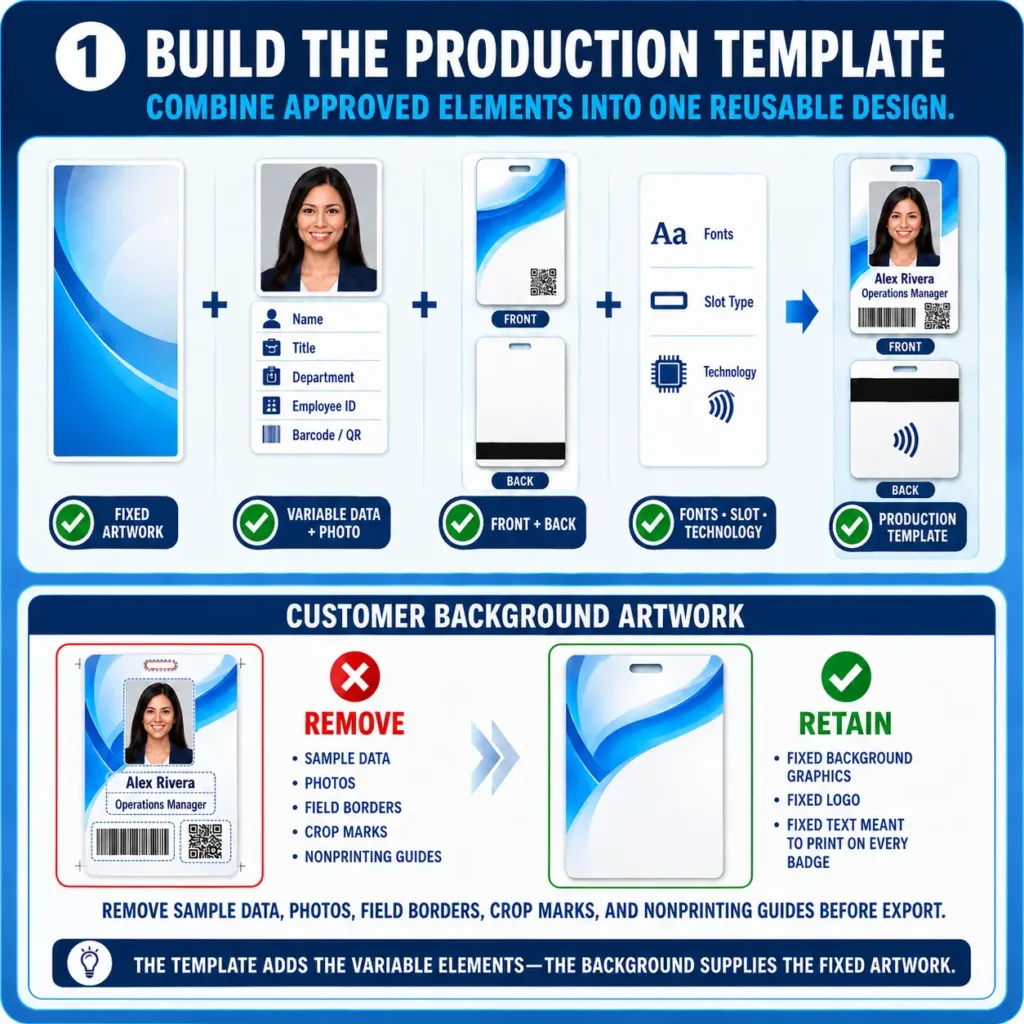
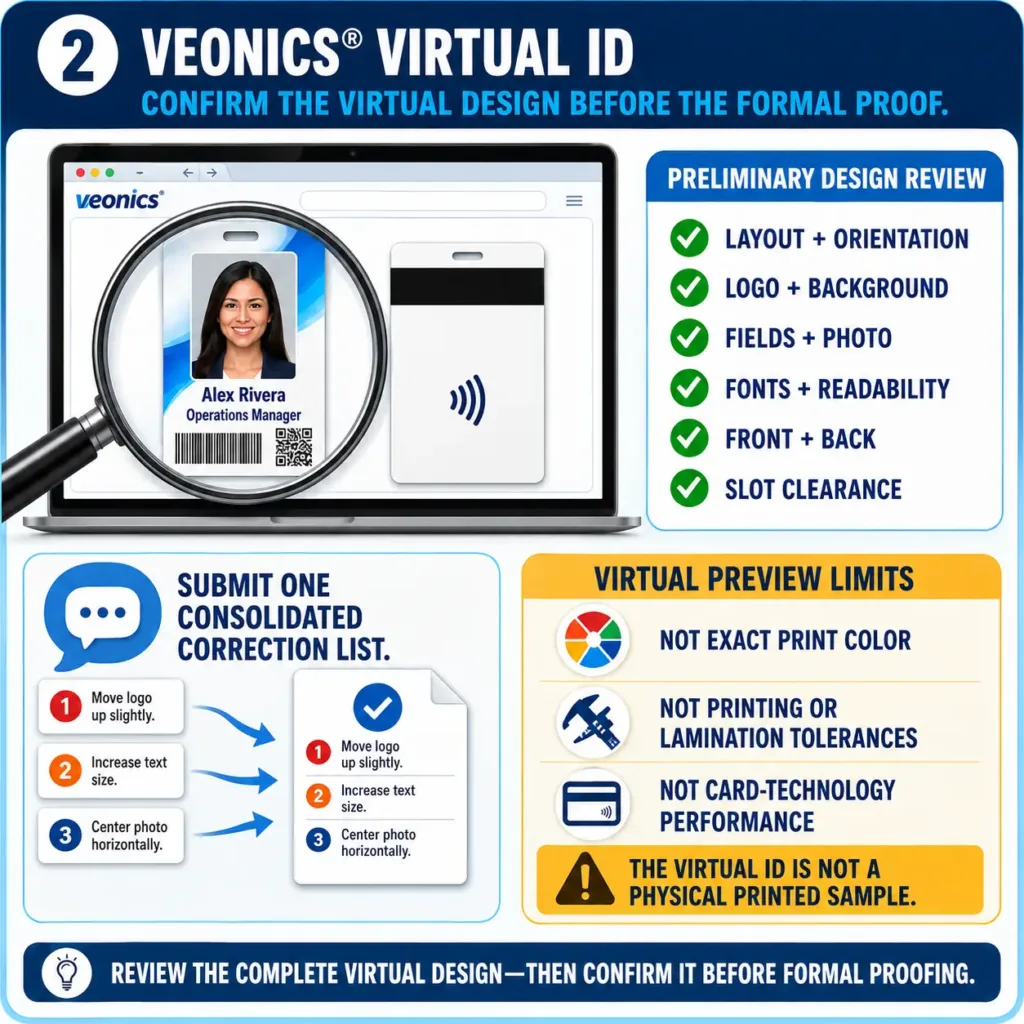
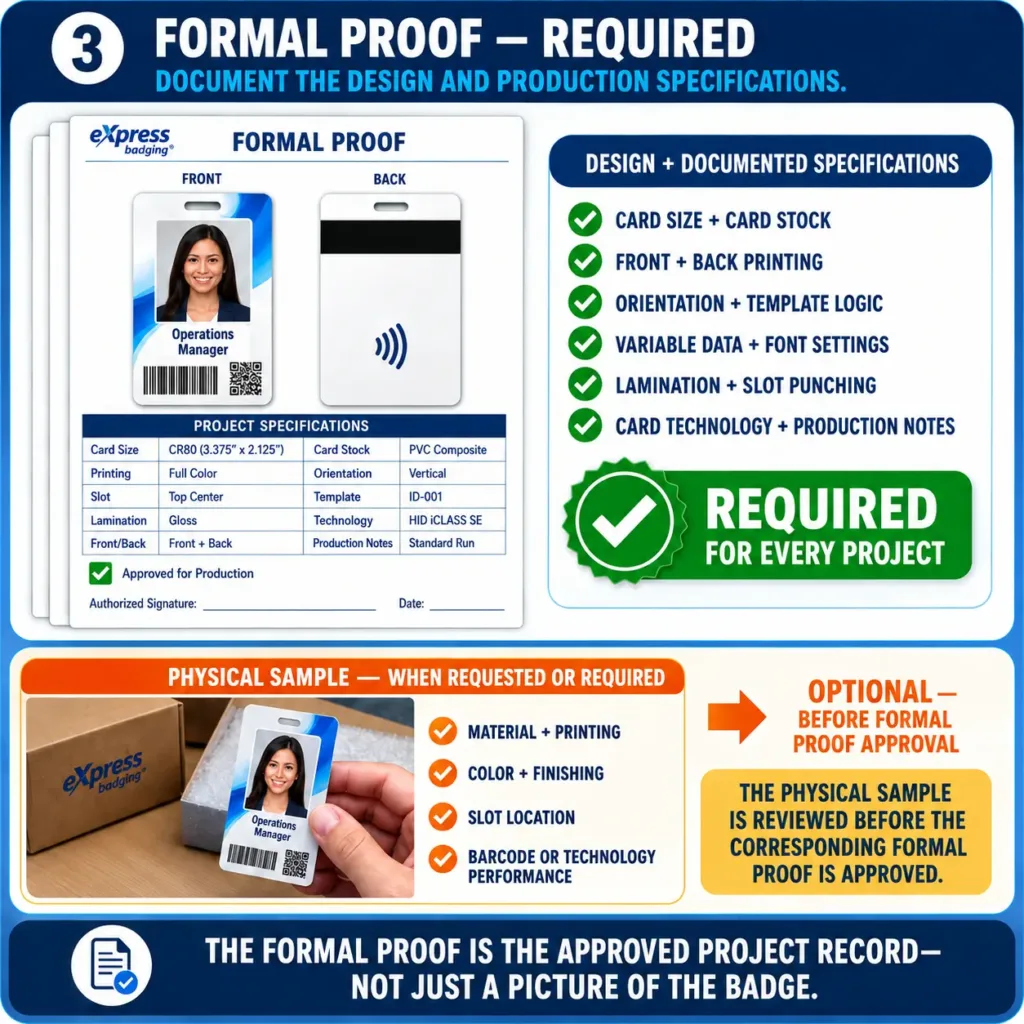
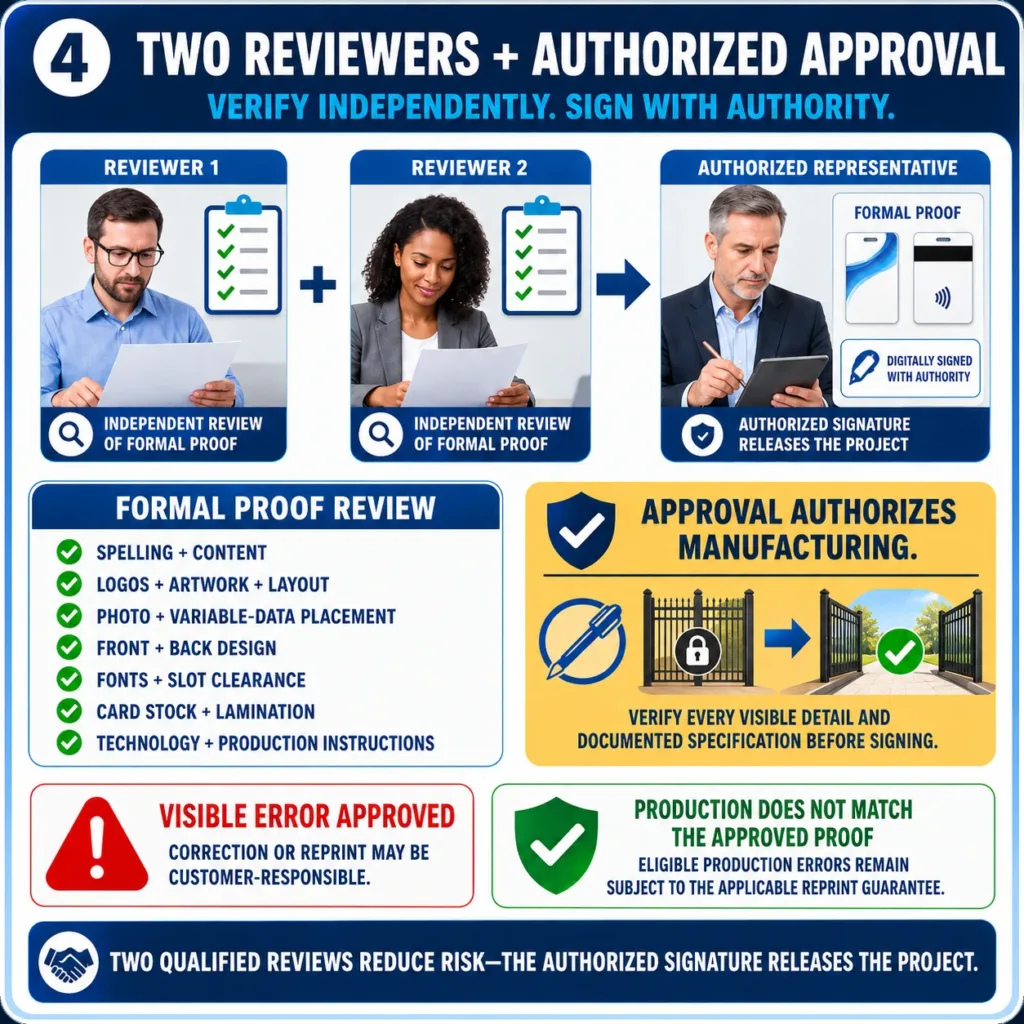
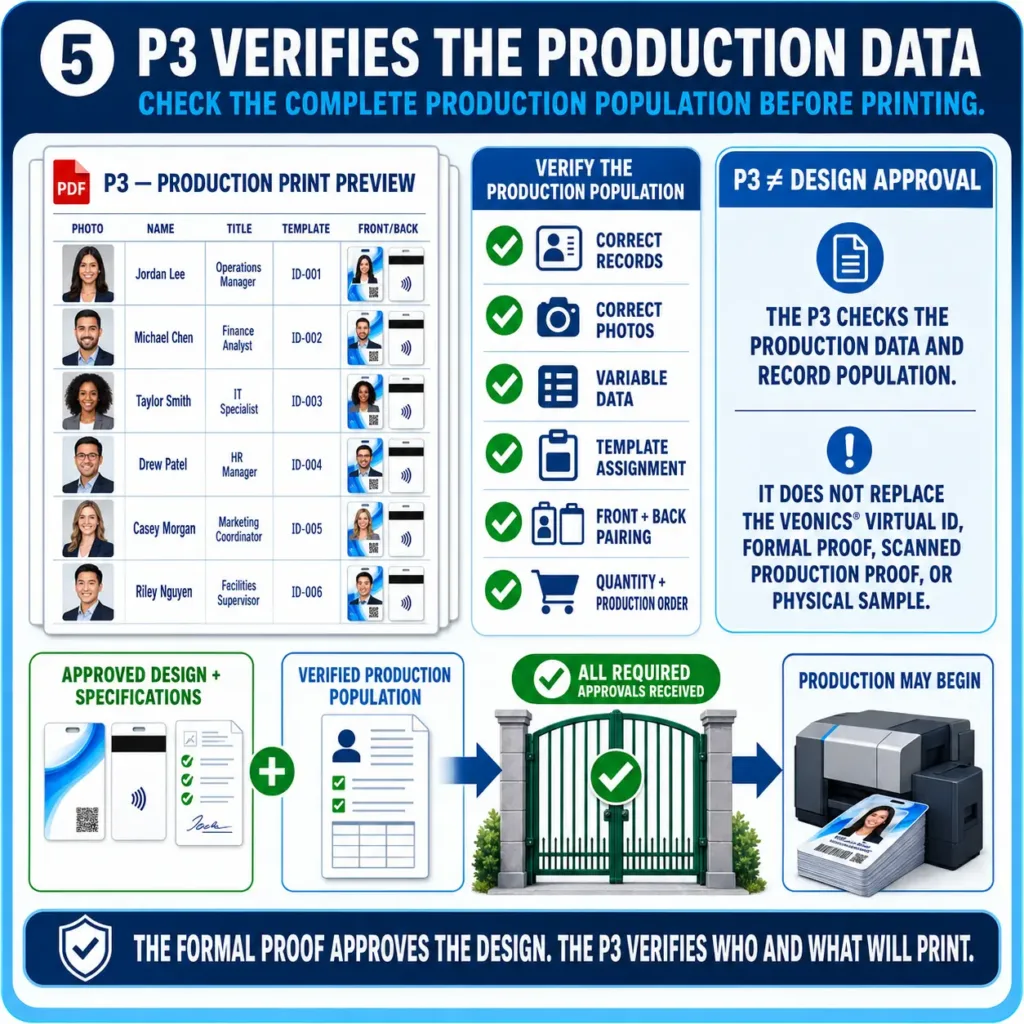
Photo ID Badge Template Edit Options
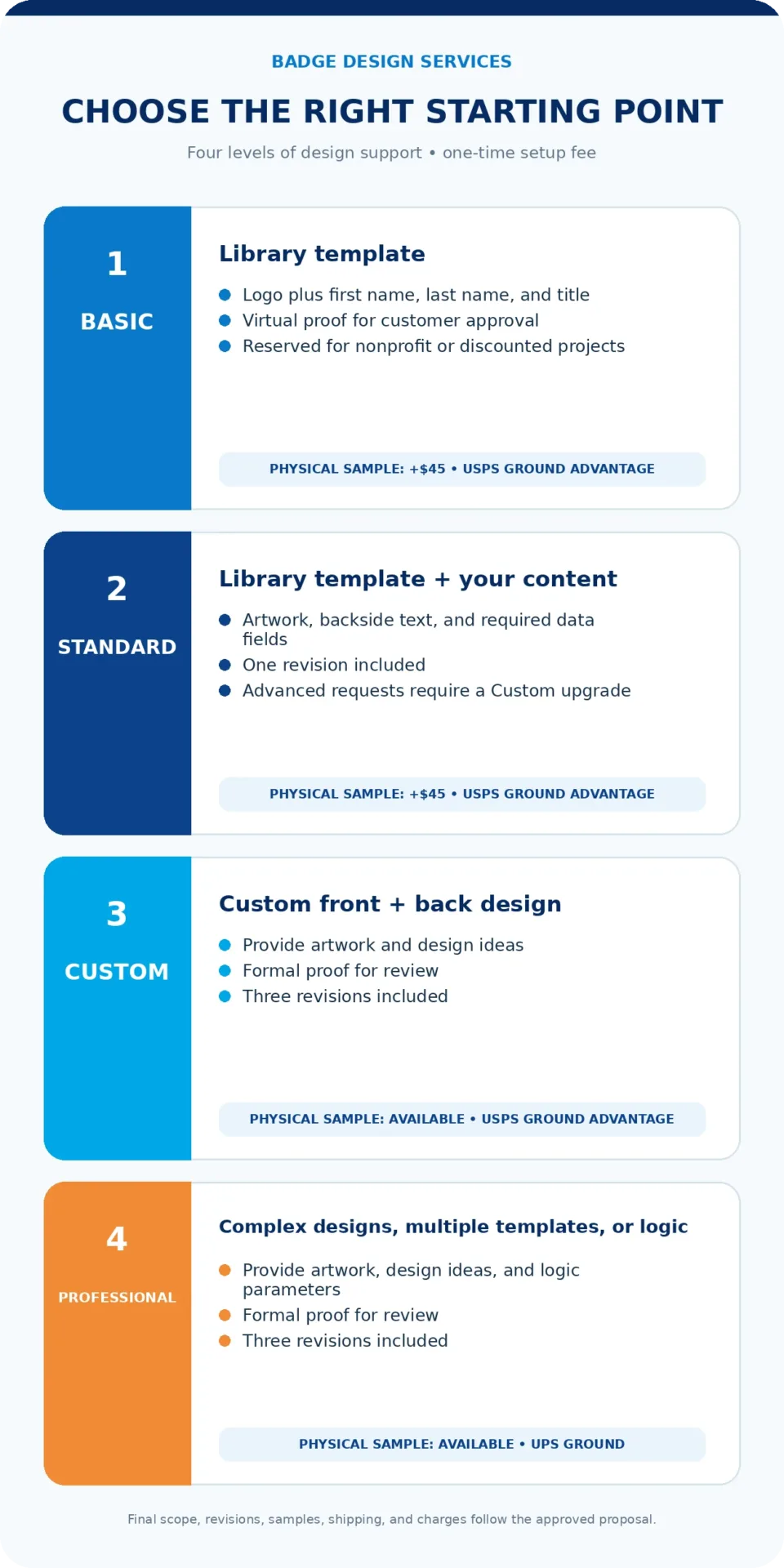
Basic Template Design
Basic Template Design is intended for organizations that select an existing design from the eXpress badging® Template Library and require little or no customization.
- Select the applicable badge design from the Template Library.
- Submit all requested edits with the original artwork and project files.
- Permitted edits may be limited to approved font selections, font size, text color, photo-border color, and similar minor changes.
- A Veonics® Virtual ID hyperlink will be provided for preliminary review.
- A formal proof will be provided for authorized approval before production.
- The formal proof may use an image from the approved vID unless a scanned production proof or physical sample is included in the approved project requirements.
- Additional changes or review rounds outside the included scope may require an approved design-change charge.
Organizations requiring greater control over the layout, artwork, variable fields, revision process, or production testing should select Standard Template Design or Custom Design.
Standard Template and Custom Design
Standard Template Design and Custom Design provide greater control over the badge layout, artwork, variable fields, and production requirements.
- Customer-provided artwork, mockups, or design concepts are used as the guide for creating the final production template.
- The eXpress badging® Production team configures the applicable variable data, photographs, font settings, printing specifications, and production requirements.
- A Veonics® Virtual ID hyperlink is provided for preliminary design review.
- A formal proof is prepared after the virtual design has been confirmed.
- The formal proof may include scanned images of an actual printed test badge.
- A physical printed sample may be requested before the formal proof is approved.
- The signed formal proof must be received before badge production begins.
- A P3 may also be provided when production-data verification is included or required.
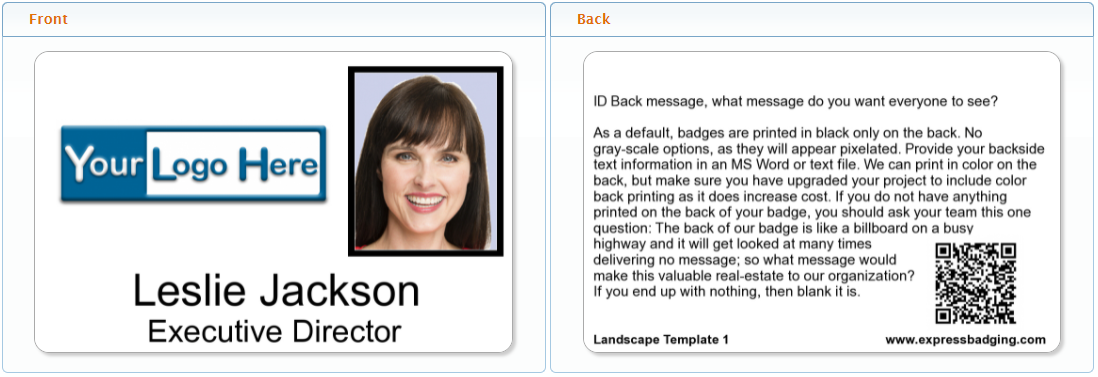
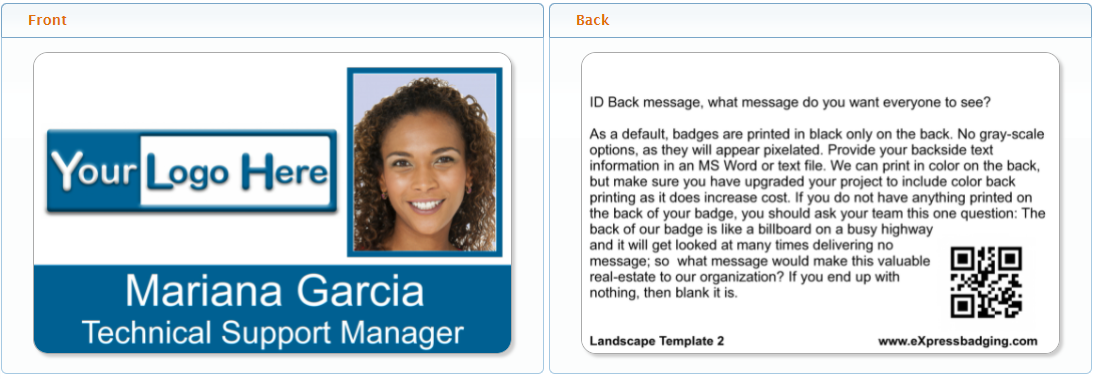
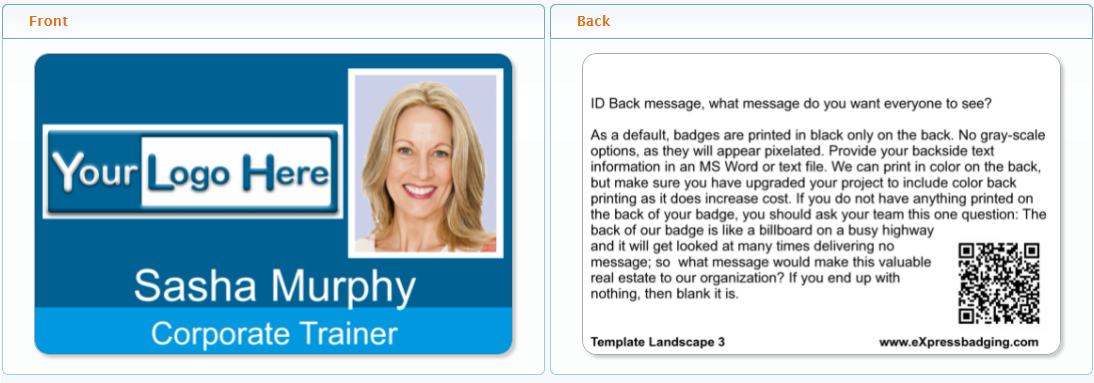
Sample Badge Templates
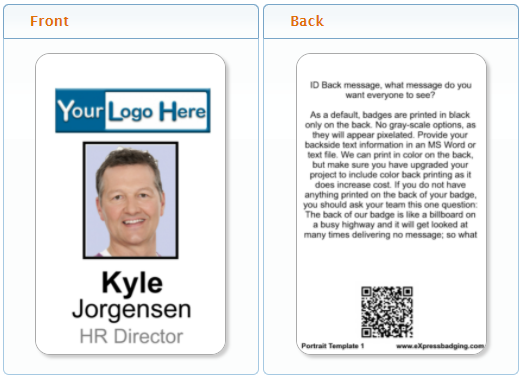
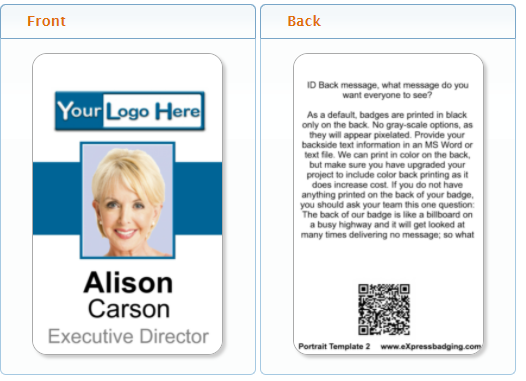
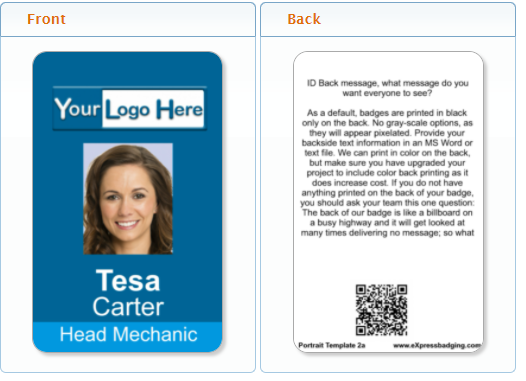
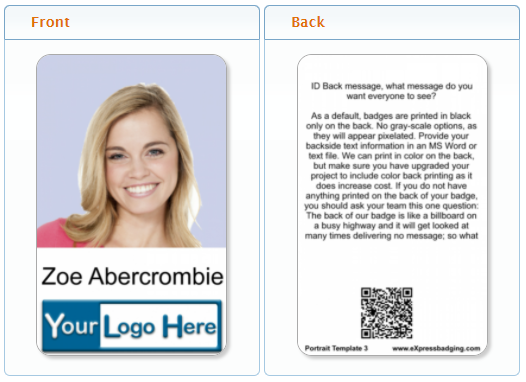
Click on an image below to see the virtual badge.
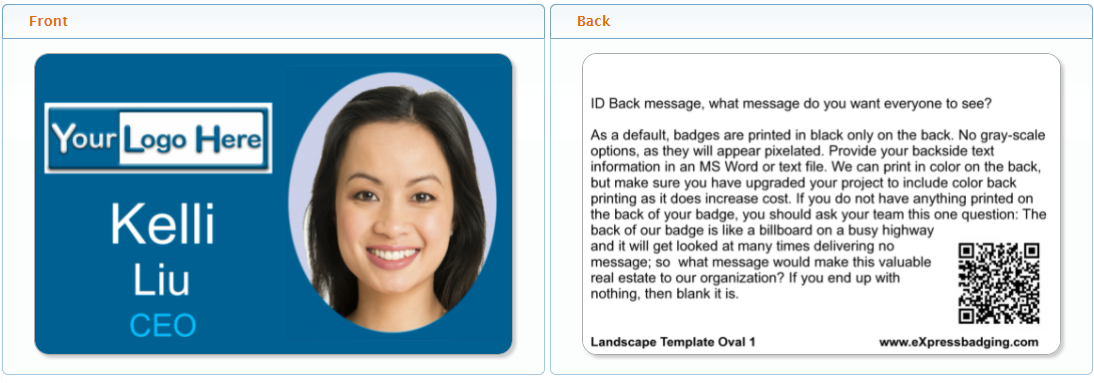
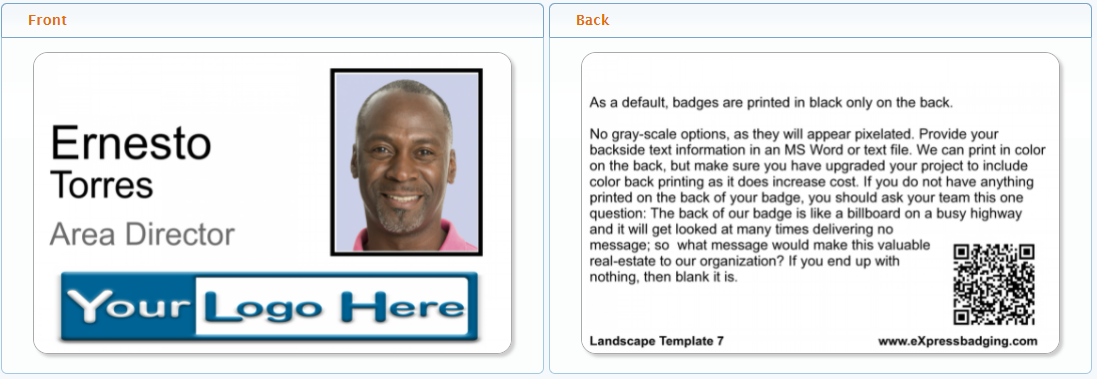
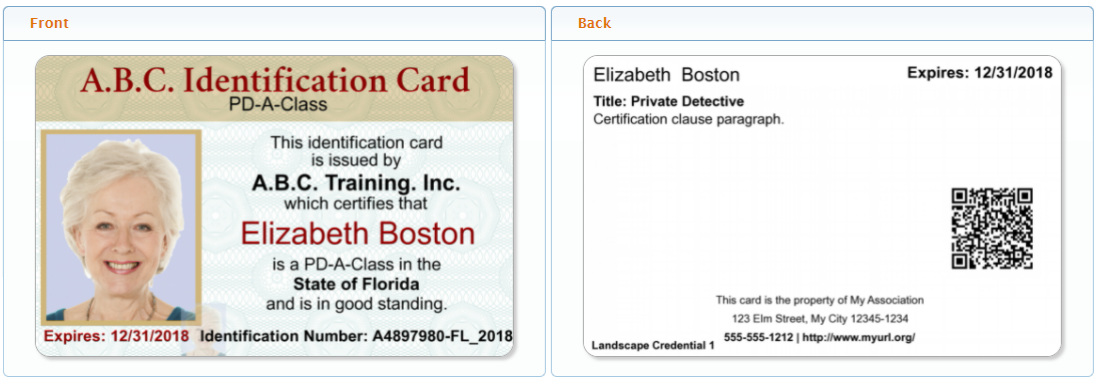
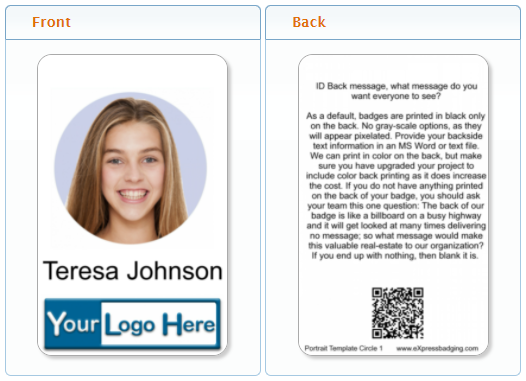
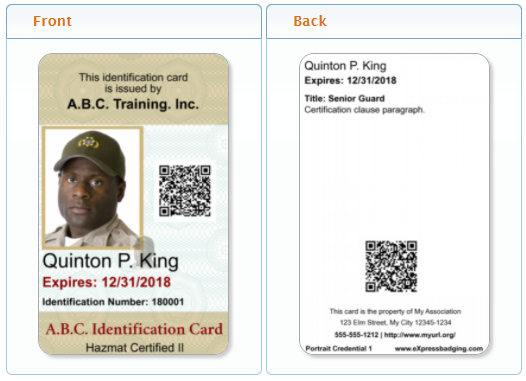
FILE to PRINT: Printing from Individual Badge Images
FILE to PRINT is intended for customers who create a separate, completed image for each ID badge. Every submitted image must contain the complete badge design, photograph, fixed text, and variable information exactly as it should print.
The eXpress badging® Production team does not proofread, crop, reposition, resize, retouch, correct, or rebuild individual FILE-to-PRINT images. Files that meet the required specifications will be printed as submitted, subject to the approved production specifications and normal printing tolerances.
If a file does not meet the requirements below, the project may be placed on hold while corrected files are requested. When available, professional artwork or file-correction services may be quoted and will not begin without customer approval.
When to Use FILE to PRINT
FILE to PRINT may be appropriate when:
- Your organization has the software and expertise needed to create production-ready badge images.
- Each badge has already been completely designed and reviewed.
- All photographs, names, titles, identification numbers, barcodes, QR codes, and other information are already positioned within each image.
- The badge files will not require editing, data merging, photo placement, or automatic font-size reduction by the eXpress badging® Production team.
- Your organization accepts responsibility for reviewing the accuracy and print readiness of every submitted image.
- Your organization requires a specific font for variable badge data but cannot provide a font file and license that permit the eXpress badging® team to install and use it.
Required File Format
Submit one completed image for each printed badge side.
- Submit flattened JPG or PNG files only.
- Prepare all images in RGB color mode.
- Submit files at 600 DPI and the exact pixel dimensions specified below.
- PNG is generally preferred for designs containing small text, line art, barcodes, or QR codes because it avoids JPG compression artifacts.
- If using JPG, export at the highest available quality with minimal compression.
- Convert PDF, PSD, AI, SVG, Microsoft Word, PowerPoint, Canva, and other source files to completed JPG or PNG images before submission.
- Do not enlarge a low-resolution image or simply change its DPI setting. The file must contain the required number of pixels.
- Do not submit screenshots as production files.
Retain your original editable source files. The eXpress badging® Production team will use the submitted JPG or PNG images as the production artwork.
File Dimensions
A finished standard CR80 ID badge measures 3.375″ × 2.125″. FILE-to-PRINT images must include an additional 0.05″ of bleed on all four sides, producing the following required file dimensions:
- Landscape: 3.475″ × 2.225″
- 2,085 × 1,335 pixels at 600 DPI
- Portrait: 2.225″ × 3.475″
- 1,335 × 2,085 pixels at 600 DPI
The outer 0.05″ on each side is the bleed area, not a no-print area. Background colors and artwork intended to extend to the card’s edge must continue completely through this bleed area.
The finished card will be trimmed or printed within the center 3.375″ × 2.125″ area. Keep names, photographs, logos, barcodes, QR codes, and other critical information safely inside the finished edge and away from the rounded corners.
Badge-Design Requirements
Before exporting each completed image:
- Extend full-bleed backgrounds through the complete 3.475″ × 2.225″ file dimensions.
- Save the image with square corners. The physical card will have rounded corners.
- Do not add rounded-corner masks to the submitted image.
- Do not include crop marks, trim lines, border-edge lines, slot guides, registration marks, or other nonprinting guides.
- Keep important content clear of the planned slot-punch location and the surrounding attachment area.
- Prepare the text at a size of at least 6 points before converting the design to a JPG or PNG.
- Confirm that small text, thin lines, barcodes, and QR codes remain sharp and readable at the badge’s actual printed size.
- Test barcodes and QR codes using a physical printed sample when scanning performance is important.
- Review both the front and back when the project includes duplex printing.
- Confirm that the front and back images use the same orientation.
Large areas of uniform color—particularly dark or solid-color backgrounds—can make normal card-surface, printing, ribbon, and lamination variations more noticeable. Review the Color Matching and ID Badge Print Technology sections above for applicable expectations.
File Names and Print Order
Every file name must be unique. Use one consistent naming convention throughout the project.
When a specific production or sorting order is required, begin each file name with a sequential number or unique identification number. For example:
0001_smith_jane_front.png0001_smith_jane_back.png0002_jones_robert_front.png0002_jones_robert_back.png
For duplex projects:
- Use the same unique identifier for the related front and back images.
- Add
_frontand_backto clearly identify each side. - Confirm that every front image is matched with the correct back image.
- Do not use duplicate file names within different folders or ZIP files.
The production order will be based on the approved project instructions and sortable file-naming convention. Do not rely on the order in which files appear on your computer or are uploaded.
Reviewing Files Before Submission
Your organization should review every completed image before uploading it. Verify:
- Correct person and photograph
- Spelling, capitalization, punctuation, and titles
- Identification numbers and other variable information
- Correct badge design, color code, location, or badge type
- Front and backside pairing
- Badge orientation
- Image quality and pixel dimensions
- Bleed and safe-area placement
- Slot-punch clearance
- Barcode and QR-code content
- Overall readability at actual badge size
- Required production and sorting order
Because each FILE-to-PRINT image is already complete, automatic font-size reduction is not available. Long names or other information that is clipped, reduced too far, or difficult to read must be corrected within the individual image before submission.
Uploading Completed Files
Submit completed files securely through the ID Badge File Upload Center.
- Individual JPG and PNG files may be uploaded directly.
- Large groups of files may be submitted in a ZIP file.
- Include written production instructions identifying the badge orientation, front and backside requirements, card stock, lamination, slot punching, technology, sorting requirements, and other applicable specifications.
- Do not email files containing photographs, identification numbers, or other personally identifiable information unless an approved secure-email method has been established.
Proofing and Production Approval
Every FILE-to-PRINT project receives a formal proof that must be approved by an authorized customer representative before production begins.
The formal proof documents the approved production specifications and the applicable artwork that was submitted. It does not convert the project into a design-editing service or confirm that the eXpress badging® Production team has proofread every individual image.
A physical proof sample may be requested before formal proof approval when the customer needs to inspect the actual color, card material, printing, lamination, slot placement, barcode performance, or other physical characteristics.
For projects containing many unique badge images, a P3—Production Print Preview may be included or requested to review the complete production batch before printing. The P3 should be reviewed for file selection, front-and-back pairing, orientation, sorting, and the visible content of each badge.
Reprints resulting from an error contained in a submitted and approved image, an incorrect front-and-back pairing, or an incorrect customer-provided file will be produced at the customer’s expense.
This responsibility does not apply when the finished badges do not conform to the approved files, formal proof, or documented production specifications. Eligible production errors remain subject to the applicable eXpress badging® reprint guarantee.
When Merge Printing Is the Better Choice
FILE to PRINT requires your organization to create, format, name, verify, and manage a separate production-ready image for every badge side.
For most variable-data projects, the recommended process is to provide:
- A static badge-background file without photographs or variable data
- A spreadsheet containing the badge-record information
- Individual source photographs
- Instructions identifying the required badge designs and production specifications
The eXpress badging® Production team can then create a reusable merge-print template and combine the background, photographs, and variable information during production. Your organization may also use the Veonics® Portal to enter, upload, preview, approve, and submit badge records.
The merge-print process provides:
- Consistent data and photo placement
- Automatic font-size reduction for long entries
- Reusable templates for future badge orders
- Easier correction of names, titles, photographs, and other information
- More efficient management of large or recurring badge programs
- P3 review when complete production-data verification is required
Review the Template Library or contact your eXpress badging® ID Specialist if you are unsure whether FILE to PRINT or merge printing is the better option.

Production Print Preview (P3):
P3—Production Print Preview
A Production Print Preview, or P3, allows your organization to review the complete production batch before physical badges are printed. The eXpress badging® Production team generates the entire print job as a PDF and provides it through an approved secure-delivery method.
A P3 is recommended for:
- Large production orders
- Projects containing multiple badge designs or badge types
- Orders requiring specific record or sort sequences
- Duplex projects requiring front-and-back verification
- Projects involving high-cost card materials
- Orders printed on RFID, contactless, smart-card, or other technology card stock
Reviewing a P3 is especially valuable before printing on RFID or other expensive card stock because it can identify visible data, photo, template, and record-assignment errors before those cards are consumed.
A P3 does not verify RFID encoding, cloning, chip functionality, antenna performance, card-reader compatibility, barcode scanning, magnetic-stripe encoding, or other card-technology functions. When these functions are required, separate production testing may also be necessary.
What a P3 Verifies
The P3 allows your organization to review:
- Whether the correct individuals are included in the production batch
- Whether any records are missing or duplicated
- Whether names, titles, identification numbers, expiration dates, and other variable information are correct
- Whether each photograph is assigned to the correct record
- Whether any required photographs are missing
- Whether photographs are cropped, positioned, and displayed appropriately
- Whether each record is assigned to the correct badge template or badge type
- Whether the correct front and back are paired for each duplex badge
- Whether long names, titles, or other information fit and remain readable
- Whether the expected number of badges is included
- Whether the production and sort order are correct
- Whether visible barcodes, QR codes, identification numbers, or other record-specific elements contain the expected information
The P3 should be reviewed carefully at a readable magnification. Reviewers should not rely only on thumbnail images or a quick page-by-page scan.
What a P3 Does Not Replace
A P3 is a production-data verification tool. It is not a badge-design proof and should not be used interchangeably with:
- A Veonics® Virtual ID preview
- A formal badge-design proof
- A scanned production proof
- A physical printed sample
- Card-technology or encoding testing
The approved formal proof controls the badge design and documented production specifications. The P3 controls the approved record population, visible variable data, photographs, template assignments, front-and-back pairings, and production order.
Because the P3 is a PDF generated from badge-production software, it may not accurately represent:
- Exact printed color
- Card-surface appearance
- Dye-sublimation printing characteristics
- Lamination appearance or tolerances
- Precise edge-to-edge alignment
- Rounded physical card corners
- Slot-punch results
- RFID or other card-technology performance
P3 Review and Approval Process
Unless otherwise specified in the approved project requirements, the P3 process is:
- The applicable badge designs and production specifications are formally proofed and approved.
- The customer provides or approves the complete production data and photographs.
- The eXpress badging® Production team imports the records and prepares the production batch.
- The complete production batch is generated as a P3 PDF.
- The P3 is provided through an approved secure-delivery method.
- At least two authorized and qualified individuals review the P3.
- Any corrections are submitted as one consolidated and clearly documented list.
- A corrected P3 is prepared when required.
- An authorized customer representative signs the final P3 approval.
- Physical badge production begins after all required approvals have been received.
P3 approval authorizes the eXpress badging® Production team to print the records shown in the approved P3 using the previously approved badge designs and documented production specifications.
Reporting P3 Corrections
If an error is discovered, notify your eXpress badging® ID Specialist or Primary Point of Contact before approving the P3.
Before submitting corrections:
- Review the entire P3.
- Consolidate all corrections into one response whenever possible.
- Identify the affected page, record, employee, member, student, or identification number.
- Clearly describe the existing information and the required correction.
- Identify any records that must be added, removed, or moved within the production order.
- Confirm whether the correction affects the source data, photograph, badge type, front-and-back pairing, or sort order.
Do not approve the P3 with the expectation that corrections will be made afterward. All known corrections must be completed and shown in the final approved P3 before physical production begins.
Design Changes Discovered During P3 Review
The P3 is not intended for badge-design development or design approval.
If a badge-design correction is requested or discovered after the applicable formal proof has been approved:
- The project will be placed on hold.
- The approval for each affected badge design will be withdrawn.
- The corrected badge design will be prepared and formally re-proofed.
- The corrected formal proof must be reviewed and approved.
- A new P3 will be generated using the newly approved badge design.
- The new P3 must be reviewed and approved before production resumes.
A change affecting one badge design does not necessarily invalidate unaffected designs. The eXpress badging® Production team will identify which proofs and P3 pages must be replaced.
Design revisions, re-proofing, and regenerated P3 files may require additional time and approved charges.
Additional P3 Rounds and Charges
The initial P3 and the number of included review rounds are determined by the approved project specifications.
Additional P3 files required because of customer-supplied data corrections, incomplete review, newly submitted records, post-review changes, or corrections that were not consolidated may incur a charge of $25 for each additional P3.
Any additional charge will be disclosed and approved before the additional billable work begins.
A customer will not be charged to correct a P3 that does not accurately reflect the information, files, instructions, or approved badge designs properly provided to the eXpress badging® Production team.
P3 Approval and Reprint Responsibility
Reprints required because of an error visible in an approved P3, incorrect information approved by the customer, or a customer-requested change made after P3 approval will be produced at the customer’s expense.
This responsibility does not apply when the finished badges do not conform to the approved P3, approved formal proof, or documented production specifications. Eligible production errors remain subject to the applicable eXpress badging® reprint guarantee.
Protecting P3 Information
A P3 may contain photographs, identification numbers, employee or member information, and other sensitive data.
Your organization should:
- Limit access to authorized reviewers.
- Use only the approved secure-delivery method.
- Avoid forwarding the P3 through unsecured email.
- Store downloaded copies only in approved locations.
- Delete or dispose of review copies according to the organization’s applicable privacy and records-retention requirements.
Frequently Asked P3 Questions
Q: Why does the P3 not look exactly like the badge-design proof?
A: The formal proof is used to approve the badge design and production specifications. The P3 is generated from the production batch to verify records, photographs, variable data, template assignments, and print order.
Differences caused by the PDF page, screen display, or production-software output do not necessarily represent differences in the physical badges. However, if the design, content, or data shown in the P3 appears inconsistent with the approved formal proof, do not approve it. Notify the eXpress badging® team so the difference can be reviewed.
Q: Why does a badge appear off-center or slightly misaligned in the P3?
A: Badge-production software is designed to print physical cards rather than create presentation-quality PDF pages. The position of a badge image within the P3 page or PDF frame may not represent its precise position on the physical card.
The finished badges will be produced according to the approved formal proof and documented specifications, subject to normal printing and finishing tolerances. If important content appears clipped, displaced, or inconsistent with the approved proof, report it before approving the P3.
Q: Why is the upper margin larger than the lower margin?
A: Some badge designs intentionally include additional space at the top for a slot punch, clip, lanyard, or badge reel. This spacing should be consistent with the approved badge design.
If the larger upper margin was not included in the approved formal proof or appears to affect the layout unexpectedly, report it before approving the P3.
Q: Will the finished badges have rounded corners?
A: Standard CR80 cards have rounded physical corners even when the P3 displays the badge image with square corners. Important photographs, text, logos, barcodes, and QR codes must remain within the approved design safety area so they are not affected by the rounded corners.
Q: Can the P3 confirm exact printed colors?
A: No. Monitor settings, PDF rendering, software, color profiles, printers, ribbons, transfer films, card stock, and other production variables can affect color appearance.
Use the formal proof and, when color accuracy is especially important, request a physical printed sample before final approval.
Q: Does the P3 confirm that RFID cards or encoded credentials will work?
A: No. A P3 can confirm the visible information associated with each record, but it cannot verify RFID encoding, cloning, chip functionality, antenna performance, magnetic-stripe encoding, or reader compatibility. These functions require separate testing when included in the project.
Q: I found an error. What should I do?
A: Do not approve the P3. Review the remainder of the file and submit one consolidated list of all required corrections.
Identify the affected page and record and clearly explain the required change. A corrected P3 will be provided when necessary. Additional P3 rounds caused by customer-supplied corrections, incomplete review, or subsequent changes may incur an approved $25 charge for each additional P3.
Q: Can production begin while the P3 is still being reviewed?
A: No. When a P3 is required, physical production will not begin until the final P3 has been approved by an authorized customer representative and all other required approvals have been received.
ID Badge Technology Testing
Technology testing is a separate process from badge-design proofing. The eXpress badging® team requires testing and written approval whenever an ID badge or card will interact with an access-control, time-and-attendance, tracking, point-of-sale, or other badge-reader systems.
Testing verifies that the proposed card technology, credential data, and production specifications are compatible with the customer’s actual systems before full badge production begins.
Technology testing may be required for:
- RFID proximity technology operating at 125 kHz
- RFID contactless or smart-card technology operating at 13.56 MHz
- Magnetic stripes
- Barcodes
- QR codes used as system credentials
- Multiple-technology credentials
- Encoded, programmed, or cloned cards
- Other machine-readable identification technologies
A badge-design proof, Veonics® Virtual ID, P3—Production Print Preview, or visual examination of a card cannot verify reader compatibility or successful system transactions.
Customer and System Information
Before test cards are prepared, identify every system in which the finished credentials will be used.
For each system, provide the applicable:
- System purpose, such as access control, time and attendance, tracking, or point of sale
- System manufacturer and product name
- Software or system version, when known
- Reader manufacturer and model
- Reader technology and supported frequency
- Integrator or dealer
- Authorized technical point of contact
- Facility, location, or operating environment
- Credential format or encoding requirements
- Facility code, site code, badge number, sequence number, or other required credential values
- Special enrollment, programming, cloning, or transaction requirements
If multiple reader models, system configurations, facilities, or credential technologies are used, identify each applicable variation. Testing one system or reader configuration does not approve a different system or configuration.
Identifying the Existing Card Technology
Provide the eXpress badging® team with clear photographs of:
- The manufacturer’s label on the card box
- The back of an unused card, when applicable
- Any manufacturer part number or technology description
- An existing sample credential when requested and authorized
Do not rely solely on the appearance of a card. Two cards that look identical may contain different technologies, frequencies, chip types, memory configurations, credential formats, or antenna designs.
Card photographs, system information, credential values, and other security-related information should be transmitted only through an approved secure-delivery method.
Representative Test Cards
The eXpress badging® Production team will prepare representative test cards based on the customer-approved specifications.
The test cards may include applicable:
- Card stock and embedded technology
- Badge numbers or sequence numbers
- Facility or site codes
- Credential formats
- Magnetic-stripe data
- Barcodes or QR codes
- Encoding, programming, or cloning requirements
- Printed information needed to identify each test credential
The test cards are provided for compatibility testing before full production. They do not authorize production until the required testing has been completed and the Card Technology Test Form has been signed.
Unless otherwise documented in the approved project requirements, production credentials will begin with the next available sequence value following the test credential. This sequencing rule may not apply when credentials are cloned or when a different numbering process has been approved.
Confirm all numbering and sequencing requirements before signing the technology-test approval.
Required On-Site Testing
Technology testing must be performed by an authorized customer representative, system administrator, security integrator, dealer, or other qualified individual with access to the applicable systems and readers.
Each test credential must be:
- Enrolled in every system in which that credential type will be used.
- Assigned to an authorized test person or record.
- Presented to each applicable reader type or system configuration.
- Used to generate the applicable real-world transaction.
- Confirmed as accepted and correctly recorded by the system.
- Verified against the badge number, sequence number, unique credential value, and assigned person.
- Documented through a transaction report or other reliable system evidence.
Testing should confirm the applicable result, including whether the credential:
- Opens or denies access at the intended door or reader
- Records a time punch
- Creates the required tracking transaction
- Completes the intended point-of-sale transaction
- Scans correctly using the applicable barcode or QR-code reader
- Reads or writes magnetic-stripe information correctly
- Displays the correct badge number or unique credential value
- Associates the transaction with the correct person or test record
- Records the correct system, reader, location, date, and time
A successful beep, light, or reader response alone may not demonstrate a complete test. Confirm that the transaction was accepted, processed, and recorded correctly in the controlling system.
Transaction Reports and Supporting Evidence
Generate and retain a transaction report from each applicable system whenever that capability is available.
The report should document:
- System name
- Test person or record
- Test credential number
- Facility or site code when applicable
- Reader or transaction location
- Transaction type
- Date and time
- Accepted or denied result
- Successful enrollment
- Correct association between the credential and assigned person
When a formal transaction report is unavailable, retain other appropriate evidence, such as an approved system screenshot, event record, audit log, or written confirmation from the authorized system administrator or integrator.
Protect all reports and screenshots according to the organization’s privacy, cybersecurity, physical-security, and records-retention requirements.
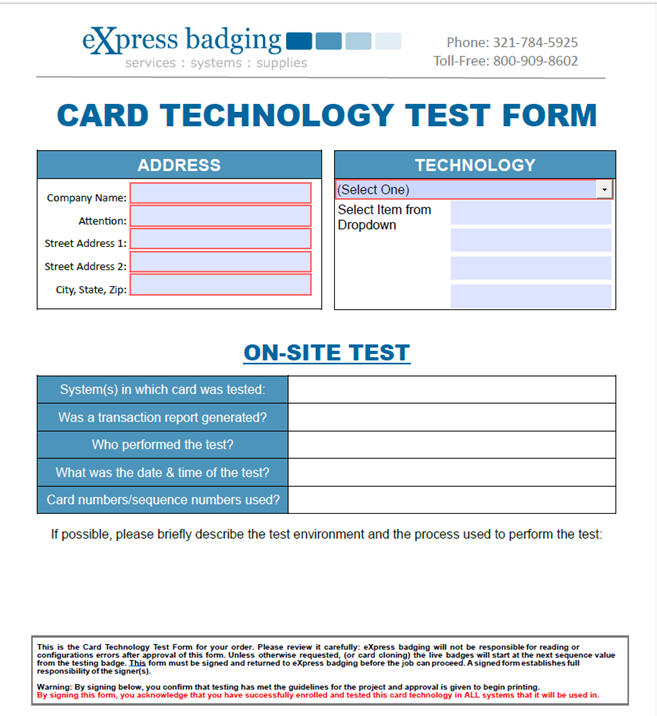
Card Technology Test Form
After testing is complete, the authorized tester must complete the Card Technology Test Form.
The completed form should identify:
- Customer organization and applicable address
- Technology or technologies tested
- Every system in which the test card was enrolled and tested
- Whether transaction reports or other evidence were generated
- Name of the individual who performed the testing
- Date and time of testing
- Card numbers or sequence numbers used
- Test environment
- Testing process
- Results and any applicable exceptions
The authorized tester must sign the form and return it to the eXpress badging® team before production can proceed.
By signing the Card Technology Test Form, the tester confirms that:
- The test cards were enrolled and tested in every disclosed system in which they will be used.
- The required transactions were successfully completed and verified.
- The technology, credential values, numbering, and sequencing are approved.
- Any system-specific exceptions have been disclosed and resolved.
- The eXpress badging® Production team is authorized to begin production using the approved technology specifications.
If a Test Fails
Do not sign the Card Technology Test Form or authorize production if a test credential fails to enroll, read, transact, or record correctly in any applicable system.
Provide the eXpress badging® team with:
- System and reader involved
- Test credential number
- Date and time of the failed test
- Expected result
- Actual result
- Error message or system response
- Transaction report, screenshot, or audit record
- Integrator or system-administrator findings
- Any configuration changes made during troubleshooting
The project will remain on hold while the card technology, credential data, system configuration, or reader compatibility is evaluated.
A revised test card may be required. If so, the new test card must be enrolled, tested, documented, and approved before production begins.
Changes After Technology Approval
Notify the eXpress badging® team before production if any approved requirement changes, including:
- Card manufacturer or part number
- RFID technology or frequency
- Chip type or memory configuration
- Credential format
- Facility or site code
- Badge-number or sequence-number range
- Encoding, programming, or cloning instructions
- Magnetic-stripe format
- Barcode or QR-code configuration
- Reader model
- System software or configuration
- Intended system, facility, or use
A material change may require revised test cards, additional testing, and a new signed Card Technology Test Form.
Testing should also be repeated before future production when a customer changes systems, readers, credential formats, card technologies, integrators, or other requirements that may affect compatibility.
Approval and Responsibility
Technology approval confirms that the representative test cards worked in the systems, reader types, and configurations disclosed and tested by the customer.
The customer is responsible for:
- Accurately identifying every applicable system and reader configuration
- Providing complete and correct technology and credential requirements
- Properly configuring and administering its systems
- Enrolling and testing each representative credential
- Verifying transaction results
- Approving credential numbers and production sequencing
- Disclosing failed tests and unresolved exceptions
- Completing the required approval before production
Reprints required because of an incorrect customer-provided specification, an undisclosed or untested system, a reader or system configuration issue, or information approved through the signed Card Technology Test Form will be produced at the customer’s expense.
This responsibility does not apply when finished credentials do not conform to the approved test card, signed technology requirements, approved numbering instructions, or documented production specifications. Eligible production errors remain subject to the applicable eXpress badging® reprint guarantee.
Technology testing does not replace badge-design approval, P3 review, physical inspection, or ongoing administration and maintenance of the customer’s badge-reader systems.
Click here to see our AI-Assisted Badge Design and Printing Review guidance for ID Badge Technology Testing.

DURAbadge™ Warranty
Badges produced in the eXpress badging® Standard format and badges produced in DURAbadge™ format provide different levels of durability and warranty protection.
Standard-Format Badges
A badge produced in the non-laminated eXpress badging® Standard format does not include a durability warranty.
Over time and depending on handling, storage, attachment method, and operating environment, a non-laminated PVC badge may:
- Experience image fading, particularly from extended sunlight or ultraviolet exposure
- Develop surface wear
- Become brittle
- Crack near the slot-punch area
- Crack or break elsewhere on the card
- Experience barcode wear that may eventually affect scanning
Fading, surface wear, cracking, breakage, and barcode deterioration resulting from the normal aging or use of a non-laminated Standard-format badge are not covered by the DURAbadge™ Warranty.
A protective badge holder may help reduce surface wear but does not provide the same protection as a laminated DURAbadge™ badge.
DURAbadge™ Format
A badge produced in DURAbadge™ format receives a 1-mil overlaminate on each laminated side. When both sides are printed and laminated, a 1-mil overlaminate is applied to each side.
The overlaminate provides additional protection against:
- Surface wear
- Image fading
- Scratching and abrasion
- Cracking
- Slot-punch-area damage
- Complete badge breakage
Badges produced in DURAbadge™ format include a two-year limited durability warranty beginning on the original ship date.
What the DURAbadge™ Warranty Covers
Subject to review and approval by the eXpress badging® Production team, the warranty covers the following conditions when they occur during regular badge use within 24 months of the original ship date:
- Cracking of the badge
- Breaking around the slot-punch area
- Complete badge breakage
- Excessive surface wear affecting an image on a laminated side
- Image fading on a laminated side
The warranty applies only to the affected badge and does not automatically apply to every badge produced in the same order or production batch. Each reported badge must be documented and evaluated.
What the DURAbadge™ Warranty Does Not Cover
The DURAbadge™ Warranty does not cover:
- Non-laminated badges produced in the Standard format
- Normal aging, fading, cracking, or breaking of Standard-format badges
- Wear or deterioration of a printed barcode on a Standard-format badge
- Incorrect customer-provided or customer-approved data, photographs, identification numbers, designs, or badge assignments
- An issue visible in an approved proof or P3—Production Print Preview
- Reader incompatibility involving an undisclosed or untested system
- Incorrect RFID, barcode, magnetic-stripe, facility-code, site-code, or credential information supplied or approved by the customer
- Normal printing, card-stock, color, graphic-placement, or lamination tolerances described elsewhere in this guide
- Damage that cannot reasonably be attributed to regular badge use
- Changes to a badge after delivery that affect its construction, slot location, laminate, printing, or embedded technology
A reported issue may require inspection before the eXpress badging® Production team can determine whether it qualifies for warranty replacement.
DURAbadge™ Warranty Claim Procedure
To submit a possible warranty claim:
- Confirm that the badge was produced in DURAbadge™ format.
- Confirm that the badge is within 24 months of its original ship date.
- Identify the original order, invoice, shipment, or customer account when available.
- Take a clear photograph of the entire front of the badge.
- Take a clear photograph of the entire back of the badge.
- Include close-up photographs showing the fading, wear, crack, slot-punch damage, or breakage.
- Identify the affected badge or cardholder without transmitting unnecessary sensitive information.
- Describe the problem, when it was discovered, and how the badge was normally used.
- Identify the number of badges experiencing the same condition.
- Submit the information to the eXpress badging® Production team or through the approved contact method.
Do not destroy or discard the affected badge until the eXpress badging® Production team provides written instructions.
After reviewing the supplied information, the Production team may:
- Approve the claim based on the photographs and supporting documentation
- Request additional photographs or information
- Request that the affected badge be returned for physical evaluation
- Provide return-shipping instructions when a return is required
- Authorize secure destruction of the affected badge
- Determine that the condition is not covered by the DURAbadge™ Warranty
When a claim is approved, the eXpress badging® Production team will provide the applicable replacement and shipping instructions.
Badges Containing RFID or Other Technology
A badge that cracks, breaks, or experiences slot-punch damage may also stop functioning in an RFID, access-control, time-and-attendance, tracking, point-of-sale, barcode, magnetic-stripe, or other reader system.
Do not destroy a technology-enabled badge that has stopped working. The eXpress badging® Production team may:
- Request that the badge be returned for evaluation
- Provide a prepaid or self-addressed return envelope
- Request additional system or transaction information
- Ask the customer to test the credential in the approved reader systems
- Authorize secure destruction after the evaluation is complete
A technology failure is not automatically a DURAbadge™ durability claim. The issue must be evaluated to determine whether it resulted from physical badge failure, production, credential data, reader compatibility, system configuration, or another cause.
Technology concerns involving RFID, barcodes, or magnetic stripes are also subject to the approved Card Technology Test Form and the ID Badge Technology Testing requirements provided above.
Relationship to the Reprint Guarantee
The DURAbadge™ Warranty addresses covered durability failures occurring during regular use within 24 months of shipment.
A badge that was initially printed incorrectly, produced on the wrong card stock, laminated incorrectly, slotted incorrectly, or delivered with technology that does not function in the approved and tested readers may instead qualify under the eXpress badging® Reprint Guarantee.
The applicable review process will depend on whether the reported condition involves:
- A production error
- A durability failure
- Customer-provided or customer-approved information
- Reader or system compatibility
- Normal production tolerances
- Damage occurring after delivery
Please contact an eXpress badging® ID Specialist if you need help determining which process applies.
Click here to see our AI-Assisted Badge Design and Printing Review guidance for DURAbadge™ Warranty Review.
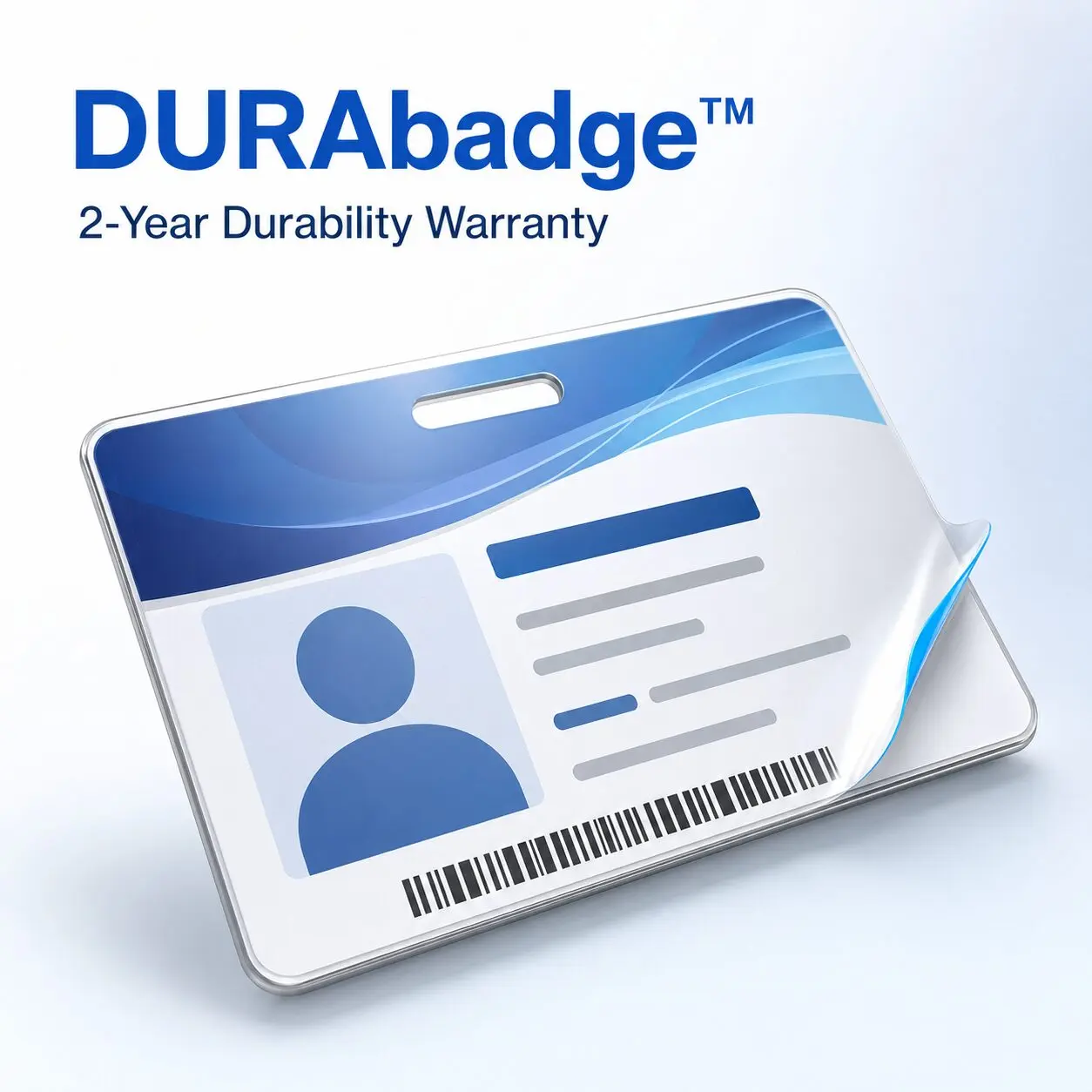
An organization-approved AI tool can serve as an additional set of eyes throughout badge design, proofing, and production preparation. It may help catch missing information, inconsistencies, and potential errors before they cause delays or reprints.
AI can assist—it cannot approve. Every finding must be independently verified through the applicable professional review, physical testing, customer approval, and production-authorization process.
Protect Your Information
Before providing files to an AI tool:
- Use only an AI platform and an account approved by your organization.
- Follow your privacy, security, acceptable use, and records retention requirements.
- Remove personal, confidential, credential, and facility-security information that is unnecessary for the review.
- Provide only the files and information required for the task.
- Never ask AI to make identity, access control, legal, licensing, security, or production approval decisions.
How to Conduct an AI-Assisted Review
- Identify the approved document, proof, spreadsheet, specification, or manufacturer information that controls the review.
- Tell the AI tool what it should compare or inspect.
- Ask it to flag possible issues without correcting files or inventing missing information.
- Independently verify and resolve every finding before approval.
Core AI Review Prompt
Act as an additional quality-control reviewer for an ID badge project. Review only the files and instructions provided. Do not approve the project, alter the files, invent missing information, or assume that something is correct merely because it appears in a supplied file.
Use [identify the approved proof, specification, spreadsheet, manufacturer document, or other controlling source] as the reference.
Review the materials for [insert the applicable section-specific review instruction below].
Report your findings in a table containing:
- File, page, badge, or record
- Confirmed discrepancy or possible concern
- Evidence supporting the finding
- Controlling source used for comparison
- Required human verification
Identify conflicting information instead of deciding which source is correct. List anything that cannot be verified, along with any expected files or information that were not provided.
1. ID Badge Print Technology
PROMPT: Compare the proposed design/s [upload] and production requirements with the documented print method, resolution, lamination, and acceptable production tolerances. Flag conflicts or requirements needing professional confirmation.
You can get very descriptive regarding your design. The more information, the better: “Please help me select the best printer technology for our photo ID badge project, and suggest three printer options. The badge will be landscape, will include our company logo [upload], large first name line one, smaller last name, we prefer the names to not truncate or run off the edge of the badge if too long, so if they can be atuomatically reduced in size to fit the name area is best which our badging software/system can manage, and printing on RFID card stock, not sure if card stock is composite or not, we do paln to slot the badge on the top long edge, we want the badges to last a minimum 3 years, longer is better, as we have low turnover, our design does include colors that run off the badge’s top and side edges, our marketing department is picking on the reproduction of our color, so select the best print technology for our uploaded logo here [upload], and we will print on the back of the badge in black only taht will include a barcode that is used in our tracking system. Here is a picture of the card reader [upload]”
2. ID Card Materials
Provide the intended environment, expected badge life, attachment method, lamination requirements, and applicable technology. Ask AI to organize these requirements and prepare questions for your eXpress badging® ID Specialist.
AI should not make the final card-stock or technology selection without verified manufacturer specifications and professional review.
3. RFID Card Printing, Lamination, and Slot-Punch Considerations
When permitted, provide the verified card-manufacturer specifications and ask AI to create a testing and compatibility checklist.
Do not ask AI to infer an antenna location, safe slot-punch area, card frequency, encoding format, or reader compatibility from an unverified photograph. Manufacturer documentation, physical samples, and reader testing control these decisions.
4. Artwork Specifications
Ask AI to create an artwork-submission inventory and check whether each required logo, background, mockup, font reference, brand-color value, and conditional graphic has been supplied.
An AI tool with file-inspection capabilities may also help flag unexpected image dimensions, low resolution, inconsistent orientation, missing transparency, or flattened files that may be difficult to edit. File properties and findings must still be independently verified.
5. Providing Artwork Files
Ask AI to organize a file manifest showing each file name, file type, intended use, badge side, design version, and related badge type.
Do not upload sensitive artwork or badge information to an unapproved AI service merely to create the manifest.
6. Color Matching
Ask AI to organize the customer-provided RGB, CMYK, and PMS reference values and flag missing or inconsistent values among the artwork, brand guide, and project instructions.
AI and screen-displayed images cannot predict or approve the exact dye-sublimation output. A physical printed sample remains the appropriate method for review when color accuracy is especially important.
7. Full-Bleed Designs, Multiple Designs, and Color Coding
Ask AI to convert the badge-assignment requirements into a cross-reference table identifying:
- Source-data field
- Approved field value
- Assigned badge design
- Assigned color
- Front and backside requirements
- Applicable exceptions
AI may also compare the cross-reference with an approved source spreadsheet and flag unmatched, duplicated, blank, or unexpected values.
8. Fonts and Font Licensing
Ask AI to identify the font family, style, weight, and version stated in the submitted materials and prepare a list of licensing questions requiring verification.
AI may summarize supplied license language, but it should not be relied upon to provide a legal opinion or determine that a font license permits third-party, server, software-as-a-service, browser, PDF-generation, or commercial badge-production use.
9. Font Attributes and Automatic Font-Size Reduction
Provide a properly redacted list of representative field values and ask AI to identify:
- The shortest entry
- Typical entries
- The longest entries
- Unusually long names or titles
- Entries containing accented or special characters
- Possible abbreviation standards requiring human approval
Use those findings to select meaningful test records. AI cannot confirm actual text fit until the values are rendered using the approved font, field dimensions, and template settings.
10. Badge Photos and Orientation
An organization-approved AI tool may help flag:
- Missing photographs
- Duplicate or repeated images
- Incorrect aspect ratios
- Low-resolution images
- Unexpected portrait or landscape orientation
- Faces that appear unusually small, off-center, or visibly cropped
AI findings require human review. Do not ask an AI tool to identify an individual from a photograph or determine whether a photograph belongs to a specific person unless your organization has expressly authorized that process and provided an approved reference source.
11. Backside Printing
Ask AI to help organize possible backside content based on the badge’s purpose. Examples include emergency instructions, security reminders, important telephone numbers, return instructions, Core Values, or an approved QR-code destination.
All proposed security, legal, safety, Human Resources, and organizational language must be reviewed by the appropriate customer representative before approval.
12. Slot-Punch Planning and Card Durability
Ask AI to create a clearance checklist comparing the front and backside designs with the approved slot guide.
AI may help identify content that appears close to the planned slot area, but it cannot confirm the physical punch location, embedded antenna location, attachment clearance, or finished durability. These items require verified specifications and physical testing.
13. Design Templates and Proofing
Ask AI to compare the Veonics® Virtual ID, formal proof, approved customer instructions, and earlier proof versions. It may help flag:
- Spelling and punctuation differences
- Missing or changed fixed text
- Inconsistent front and backside content
- Unexpected design or specification changes
- Missing production notes
- Differences in orientation, field labels, or template assignments
- Unresolved comments from an earlier review
- Items requiring human inspection
AI-assisted review does not replace review by at least two authorized and qualified individuals or approval by an authorized customer representative.
14. Sample Badge Templates
Provide AI with the organization’s operational requirements—not confidential employee data—and ask it to create a design-requirements brief. The brief may address desired orientation, required fields, photo treatment, color coding, backside use, slot clearance, and general design priorities.
AI-generated artwork or design concepts may contain inaccurate text, distorted logos, unusable QR codes, unlicensed content, or production-incompatible elements. Treat generated concepts as visual references, not production-ready artwork.
15. FILE to PRINT
An approved AI tool may help audit a group of completed badge images for:
- Missing or duplicate file names
- Missing front or back images
- Inconsistent
_frontand_backnaming - Incorrect sequence or sort order
- Unexpected image dimensions
- Inconsistent orientation
- Visible blank fields
- Repeated or missing photographs
- Clipped or unusually small text
- Apparent template or color-code inconsistencies
AI cannot confirm that the information or photograph is correct without an approved reference source. Every completed image remains subject to customer review before submission and production approval.
16. P3—Production Print Preview
AI-assisted review is especially useful for large P3 files. When authorized, compare the P3 with the approved production roster or source spreadsheet and flag possible missing records, duplicates, photo concerns, blank fields, template-assignment differences, front-and-back pairing problems, and unexpected sort-order changes.
Use the detailed Optional AI-Assisted P3 Review instructions and sample prompt provided in the P3 section below.
17. ID Badge Technology Testing
Ask AI to create a testing matrix identifying each:
- Badge or card type
- Technology and frequency
- Reader system
- Facility or test location
- Assigned test credential
- Required transaction
- Expected result
- Actual result
- Supporting report or evidence
- Unresolved exception
AI may also summarize transaction reports and flag missing test results. It cannot activate a credential, test a physical reader, confirm encoding, or replace enrollment and transaction testing in every applicable system.
18. DURABadge™ Warranty Review
Ask AI to organize the order date, ship date, reported problem, affected quantity, badge photographs, card type, lamination, usage conditions, and supporting documentation into a concise issue summary.
AI cannot determine warranty eligibility or authorize replacement. Final warranty review must be completed by the eXpress badging® team.
Reusable AI Review Prompt
Use the following prompt as a starting point. Replace the bracketed instructions with the applicable project information.
Act as a supplemental quality-control reviewer for an ID badge project. Review only the attached files and instructions. Do not approve the project, invent missing information, make identity determinations, or assume that information is correct merely because it appears in a supplied file.
Review the materials for the following purpose: [describe the requested review].
Use [identify the approved proof, roster, specification, manufacturer document, or other controlling source] as the reference. If two supplied sources conflict, identify the conflict instead of deciding which one is correct.
Check for: [list the applicable issues from the AI-Assisted Review Opportunities above].
Report the results in a table containing:
- File, page, badge, or record
- Suspected issue
- Evidence or reason for the finding
- Controlling source used for comparison
- Recommended human verification
Clearly distinguish confirmed discrepancies from possible concerns. If something cannot be verified from the supplied files, state that it requires human review. Finish by listing the files reviewed, files expected but not supplied, total items reviewed, and total issues flagged.
AI tools may produce incorrect findings, overlook visible problems, misunderstand project requirements, or interpret source files inconsistently. AI-assisted review is an additional quality-control resource—not a substitute for professional production work, physical testing, qualified human review, or authorized approval.
