

Most organizations that set out to evaluate a badging program eventually arrive at the same quiet worry. It is rarely spoken out loud, but it sits under every conversation about equipment, vendors, and cost.
“Am I choosing the wrong approach?”
It is a fair thing to worry about. A badging decision touches security, facilities, human resources, and often compliance. It gets budgeted once and lived with for years. Choose in-house printing and you may wonder later whether you overbought equipment you rarely use. Outsource it and you may wonder whether you gave up control you needed. Either way, the fear is the same. The model you pick might quietly work against you.
Here is the honest answer, and it is the reason this guide exists. There is almost never one correct model for an organization. There is a correct model for a situation, and most organizations move through several situations over the life of a credentialing program.
A company issuing a few badges a week has different needs than the same company opening three new facilities next quarter. A hospital protecting patient data has different priorities than a distributor rebranding after an acquisition. None of these organizations is choosing wrong. They are simply in different places.
The goal here is not to steer you toward a product. It is to give you a clear way to read your own situation, so that whatever you choose, you can explain exactly why it fits. When you can articulate the why, the anxiety tends to go away.
We Print, You Print and a better way to frame it
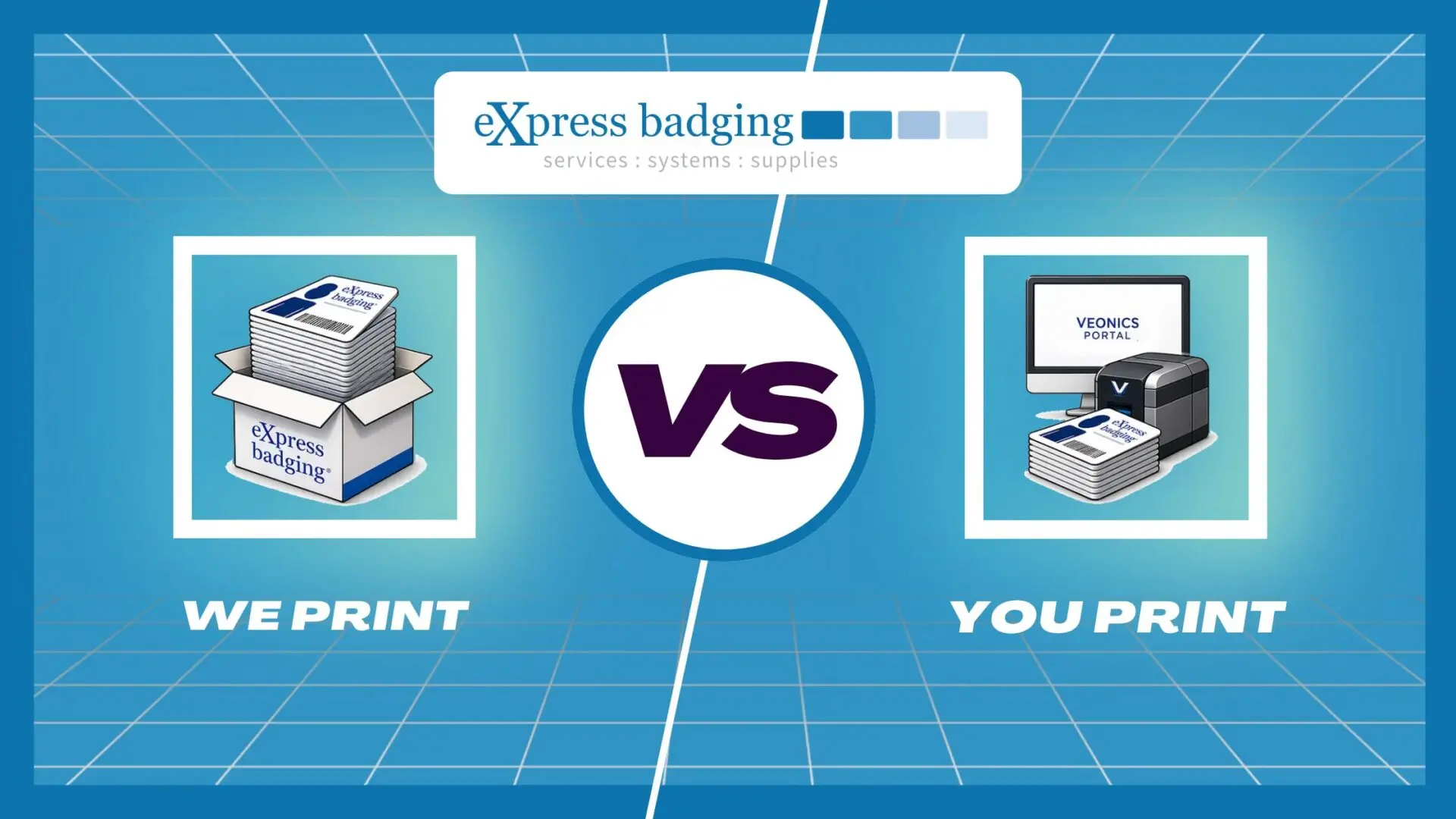
We Print means the production work is handled by an outside partner who receives your data and design, prints to specification, and returns finished, ready to issue credentials.
You Print means badging happens inside your walls. You own or lease the printers, hold the card stock and consumables, run the software, and issue credentials on your own schedule.
People tend to argue these as opposites, as if one has to be permanently right and the other permanently wrong. That framing is where the anxiety comes from. It sets up a single, high stakes decision with a winner and a loser, and it invites the fear of picking the loser.
A more useful frame is this. Each model is a tool suited to a particular kind of job. A production printer and a desktop unit are not competitors any more than a freight truck competes with a delivery van. They do different work well. The real skill is not declaring one of them correct. It is learning to read the job in front of you and reaching for the model that fits it.
When in-house badging wins
In-house printing is the right answer far more often than buyers expect, because most credentialing work is ordinary, ongoing, and unpredictable in timing. That is precisely the work it handles best.
Control overtime. When you need to issue on your own terms, an in-house setup answers to no one else’s queue. New hire starting Monday, contractor arriving this afternoon, a badge lost at the front desk. You handle it immediately without a purchase order or a shipping window.
Speed for every day, unpredictable issuance. Steady day to day volume that arrives a few at a time is where in-house shines. Instant replacement, same day onboarding, and visitor credentials all favor having the capability on site rather than waiting on a turnaround.
Data security and chain of custody. For regulated or sensitive environments, keeping cardholder data, photos, and personal information inside your own systems can simplify your compliance story. Nothing leaves the building, and you control exactly who touches it.
In-house is likely the right fit when:
- Your volume is steady and spread across the year rather than concentrated in bursts.
- You frequently need same day or on demand issuance for new hires, visitors, or replacements.
- You operate in a regulated setting where keeping personal data in house eases compliance.
- You have staff who can own the process, the equipment, and routine maintenance.
When outsourced printing is the smarter call
Outsourcing is not a fallback for teams that cannot manage their own printing. It is often the deliberate choice of large, sophisticated operations, because some jobs were never meant for in-house equipment.
Scale without owning the burden. Producing thousands of credentials means industrial throughput and consumables at volume. A partner absorbs that load so you are not buying equipment to handle a peak you hit only occasionally.
Hard deadlines and surge events. Campus openings, conferences, seasonal hiring, and event credentialing share one trait. A fixed date and a large one-time volume. That is where an in-house printer becomes a bottleneck and a partner becomes a relief valve.
Organization wide rebadging. Rolling out a new design, migrating technology, or refreshing every badge is a project, not a routine. A partner runs it in parallel while your daily operations keep moving.
Branding and finish consistency. When credentials represent the brand, specialty finishes and uniform quality across a large run are easier to guarantee through production printing than on a single desktop unit.
Mergers, acquisitions, and rapid growth. Absorbing an acquired company or scaling headcount fast can mean thousands of credentials on a compressed timeline, often before your internal systems have caught up. A partner lets you move at the speed of the deal.
Outsourcing is likely the right fit when:
- Volume arrives in large bursts tied to events, seasons, or growth.
- You face a fixed deadline with a one-time credential run at scale.
- You are rebadging the organization or rolling out a new design or technology.
- Brand quality and consistency across a large run are priorities.
- An acquisition or hiring surge has outpaced your internal capacity.
Why many organizations run both over time
Here is what quietly resolves the original anxiety. The most mature credentialing programs rarely pick one model forever. They use each where it fits, and they shift the mix as their situation changes.
This is not indecision, and it is not a failure of planning. It is simply what a program looks like once it has been through a few real cycles. Consider how it tends to play out.
An organization outsources a large initial rollout, or an organization wide rebadge, because that is a scale and deadline job. Once every credential is issued and the design is set, daily maintenance becomes a trickle of new hires and replacements, so they bring that steady work in house for speed and control. Then an acquisition doubles headcount overnight, and they lean on their partner again for the surge, before settling back into in house issuance once the dust clears.
The same organization used both models within eighteen months and was right to do so each time. The volume pattern changed, so the correct tool changed with it.
The question is not “which model are we?” It is “which model fits the job in front of us right now, and how easily can we switch when the job changes?”
If you have been treating this as a permanent, one-time commitment, you can lower the stakes considerably. You are not marrying a model. You are choosing what fits your current situation while keeping the option to flex. The organizations that sleep well are the ones who have a clear read on their volume pattern and a partner relationship they can turn on when a surge, a deadline, or a rebadge arrives.
Four questions that tell you where you land
You can get a reliable read on your own situation in a single meeting. Work through these four questions honestly. There are no wrong answers, only signals about which model fits the job you have today.
- What does your volume pattern look like? Leans You Print if it is steady, spread across the year, and arrives a few at a time. Leans We Print if it is concentrated in bursts tied to events, seasons, or growth.
- How tight and how large is your timeline? Leans You Print if it is ongoing and flexible, with a need for same day issuance. Leans We Print if you face a fixed deadline with a large one time run to produce.
- How sensitive is the data involved? Leans You Print if it is regulated or sensitive, where keeping data in house eases compliance. Leans We Print if it is standard sensitivity, comfortably handled under a partner agreement.
- What is your internal capacity to own the process? Leans You Print if you have staff and time to run equipment, software, and maintenance. Leans We Print if capacity is limited, or a spike outpaces the team you have.
Most organizations find their answers split across both columns. That split is not a problem to solve. It is the map. It tells you which parts of your program belong in house, and which belongs with a partner.
Quick reference: matching the situation to the model
| If your situation is | The model that usually fits |
| Steady daily issuance | YouPrint, for control and speed |
| A large launch or rebadge | WePrint, for scale and deadlines |
| Regulated, sensitive data | YouPrint, for chain of custody |
| M&A or a growth surge | WePrint, to move at deal speed |
| Brand critical, large runs | WePrint, for finish and consistency |
| Both steady and spiky | A hybrid of both, by design |
There is no wrong approach, only a wrong fit
If you take one thing from this guide, let it be this. The anxiety of choosing the wrong badging model comes from believing you must pick one answer and defend it forever. You do not.
You have to read your situation, match the model to the job, and keep the flexibility to shift as things change. An organization that issues a handful of credentials a week and one that is rebadging ten thousand people are not making the same decision, and they should not reach the same conclusion. Both can be completely right.
When you can look at your volume pattern, your timeline, your data, and your internal capacity and say plainly why a given model fits, the decision stops feeling risky. It becomes what it always was. A practical choice about the job in front of you.
At eXpress badging, we support both models because we have watched enough organizations move between them to know that neither is a permanent state. Our aim is not to talk you into printing your own badges or into handing the work over. It is to help you see your situation clearly, so the model you choose is the one that genuinely fits, today and as things change. When you are ready to map your own program against the four questions above, we are glad to think it through with you.
